
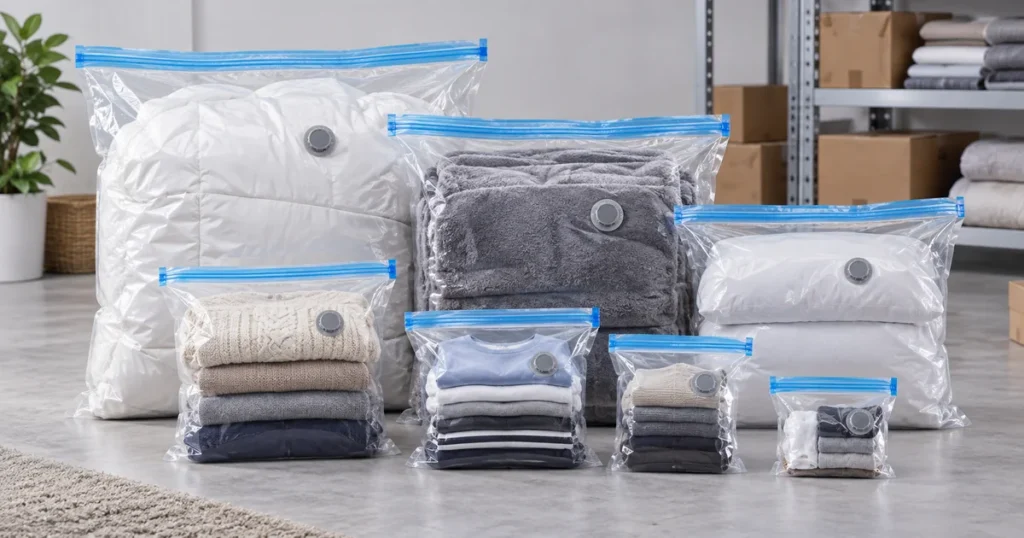
Choosing the right vacuum storage bag sizes involves more than simply labeling products Small, Medium, Large or Jumbo.
For importers, wholesalers, distributors and private-label brands, bag dimensions can affect product usability, retail assortment, packaging dimensions and the way customers understand each SKU.
A well-planned size range should cover different storage applications without creating too many similar products.
This guide explains how B2B buyers can select vacuum storage bag sizes for clothing, bedding, travel and retail sets.
Vacuum Storage Bag Size Chart
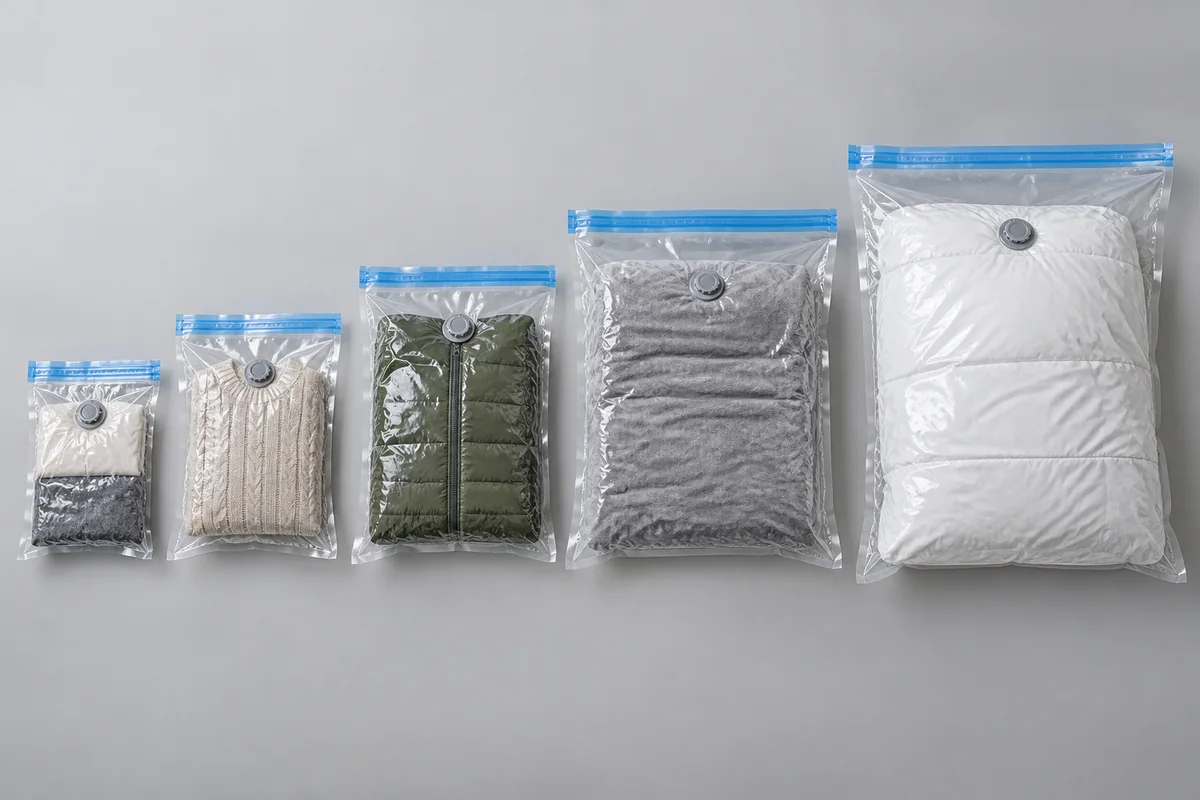
There is no universal industry standard for terms such as Small, Medium, Large or Jumbo.
A “Large” vacuum bag from one supplier may have completely different dimensions from a “Large” bag supplied by another manufacturer.
For B2B purchasing, buyers should always confirm the actual dimensions.
| Bag Size | Approx. Inches | Typical Application |
|---|---|---|
| 60 × 40 cm | 23.6 × 15.7 in | Travel clothing and small garments |
| 70 × 50 cm | 27.6 × 19.7 in | Shirts, sweaters and everyday clothing |
| 80 × 60 cm | 31.5 × 23.6 in | Jackets, clothes and lightweight blankets |
| 90 × 70 cm | 35.4 × 27.6 in | Bulky garments and bedding |
| 100 × 80 cm | 39.4 × 31.5 in | Quilts, comforters and large bedding |
These dimensions are examples rather than universal standards.
The right size depends on the intended contents, bag construction, packaging format and target market.
Why Vacuum Storage Bag Size Matters
Bag size affects more than storage capacity.
A bag that is too small can make loading difficult and place unnecessary pressure around the zipper and sealed edges.
A bag that is unnecessarily large may use more material, increase folded package size and create an awkward compressed shape.
For wholesale and private-label projects, buyers should consider:
- What customers will store
- Whether the bag is designed for clothes or bedding
- Home storage or travel use
- Number of bags per retail set
- Finished retail packaging dimensions
- Shipping carton efficiency
- Target retail price
- Whether different sizes will be combined
The goal is not to offer the largest bag possible.
The goal is to create a practical size range in which each size has a clear purpose.
60 × 40 cm Vacuum Storage Bags
A compact size such as 60 × 40 cm can work well for smaller garments and travel-oriented storage.
Typical applications include:
- T-shirts
- Underwear
- Children’s clothing
- Lightweight garments
- Travel clothing
Compact vacuum bags are especially useful when the compressed bag still needs to fit inside luggage. Buyers can compare purpose-built travel compression bags when planning compact sets.
For travel-oriented product ranges, buyers may also combine smaller bags with a compatible hand pump.
70 × 50 cm Vacuum Storage Bags
The 70 × 50 cm size provides more loading space while remaining convenient for everyday clothing storage.
Possible applications include:
- Shirts
- Sweaters
- Towels
- Folded clothing
- Seasonal garments
This size can also be used as the smaller or medium component of a multi-size retail set.
For clothing-focused products, offering more than one dimension can help users separate smaller garments from bulky sweaters or jackets. See our vacuum bags for clothes for related assortment options.
80 × 60 cm Vacuum Storage Bags
An 80 × 60 cm vacuum bag provides additional capacity for larger garments and household textiles.
Typical applications may include:
- Sweaters
- Jackets
- Towels
- Children’s bedding
- Lightweight blankets
- Seasonal clothing
For many retail programs, this type of size can work as the middle option between clothing bags and larger bedding bags.
Instead of displaying only “Large” on packaging, buyers should consider showing the actual measurements as well.
For example:
Large — 80 × 60 cm / 31.5 × 23.6 in
This makes the product easier for customers to understand.
90 × 70 cm Vacuum Storage Bags
A larger format such as 90 × 70 cm is suitable when the product range needs to accommodate bulky clothing or bedding.
Possible applications include:
- Winter clothing
- Blankets
- Pillows
- Bedding
- Large seasonal textiles
Before mass production, the intended contents should be tested using actual samples.
Two vacuum bags with similar dimensions may perform differently depending on the film structure, zipper design, valve position and loading method.
100 × 80 cm Vacuum Storage Bags
A 100 × 80 cm vacuum storage bag provides substantially more loading area and is commonly considered for bulky household storage.
Typical applications include:
- Quilts
- Comforters
- Blankets
- Pillows
- Seasonal bedding
Large vacuum bags should be evaluated as a complete product.
As the dimensions increase, the total film area and the amount of stored material also increase.
Buyers should therefore evaluate the material, zipper, seals and valve together instead of looking only at bag dimensions.
Flat Vacuum Bags vs 3D Vacuum Storage Bags
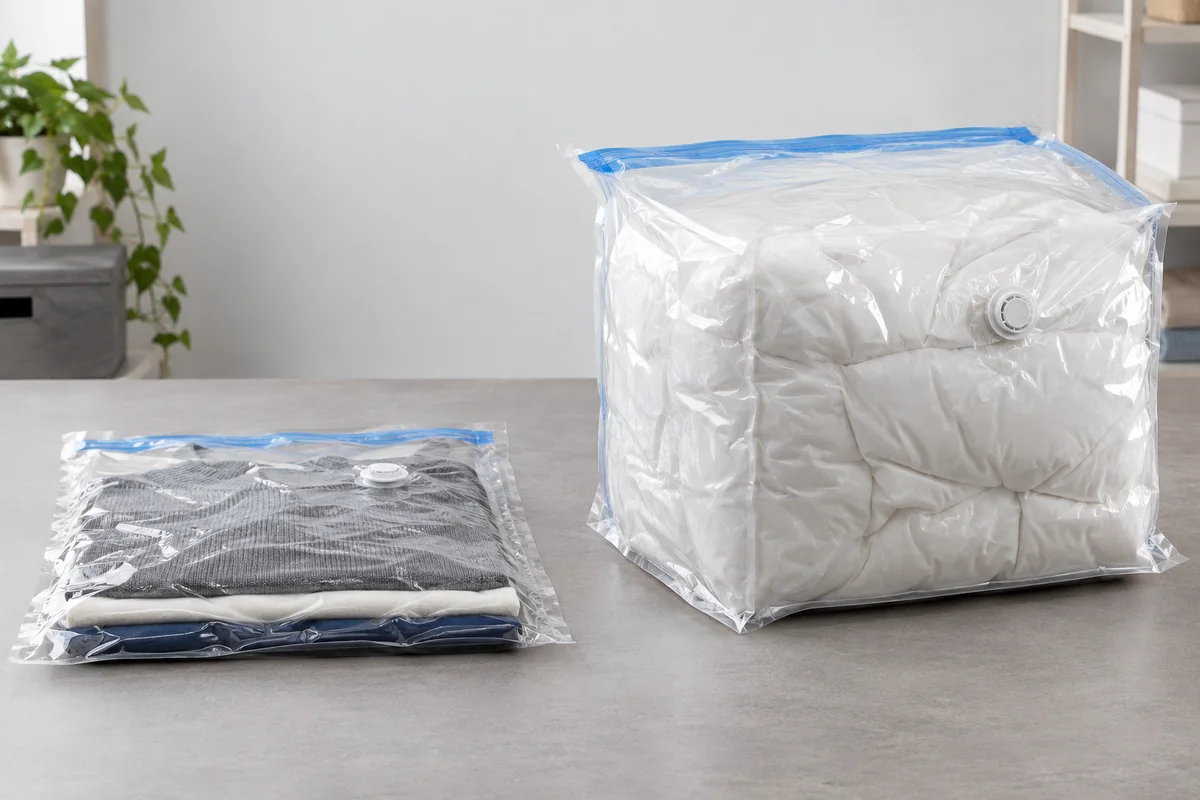
Dimensions alone do not describe the usable volume of a vacuum storage bag.
Traditional vacuum storage bags are usually flat when empty.
They are suitable for:
- Clothing
- Blankets
- Towels
- General household storage
3D vacuum storage bags include additional depth through an expanded structure.
Example dimensions can include:
- 70 × 50 × 32 cm
- 80 × 56 × 32 cm
- 100 × 80 × 32 cm
The third measurement represents the depth of the expanded bag.
This structure can be useful for bulky items such as quilts and comforters.
For B2B buyers, flat and 3D bags should therefore be treated as two different product structures rather than simply different sizes.
What Size Vacuum Bag Is Best for Clothes?
Clothing normally works well with small and medium-sized vacuum bags.
Typical products include:
- Shirts
- Sweaters
- Trousers
- Jackets
- Seasonal garments
The correct size depends on both the number of garments and how they are folded.
For retail sets, it is often better to offer two clearly different clothing sizes than several dimensions that are almost identical.
For example:
Compact size: travel and small garments
Medium size: sweaters and everyday clothing
Large size: jackets and bulkier seasonal clothes
This gives customers a clearer reason to use each bag.
What Size Vacuum Bag Is Best for Bedding?
Bedding generally requires larger bag dimensions because blankets, quilts, comforters and pillows occupy much more volume before compression.
Large flat vacuum bags can work well for many applications.
For particularly bulky bedding, a 3D structure may make loading easier because the additional depth creates more usable internal volume.
When developing bedding storage products, buyers should test the actual quilt or comforter that the target customer is likely to use.
What Size Vacuum Bag Is Best for Travel?
Travel vacuum bags should balance capacity with portability.
A very large bag may compress clothing effectively but still produce a compressed package that is difficult to fit inside a suitcase.
Travel-oriented vacuum bags therefore usually focus on smaller dimensions.
Possible retail combinations include:
- Small + Medium bags
- Multiple compact bags
- Compact bags with a hand pump
The final configuration depends on the intended luggage size and retail positioning.
How Importers Can Build a Multi-Size Retail Set
For wholesale and private-label programs, one of the most important decisions is how different bag sizes will be combined.
A simple size structure could include:
Compact
For travel and smaller garments.
Medium
For shirts, sweaters, towels and everyday clothing.
Large
For jackets, blankets and bedding.
This type of structure is often easier for customers to understand than a retail package containing several bags with only small differences in dimensions.
Before confirming a retail set, buyers should determine:
- Which storage application is most important?
- How many bags should be included?
- Will all sizes use the same valve?
- Is a hand pump required?
- How will the bags be folded?
- What is the target retail package size?
- Will the product be sold under a private label?
- Is printing required?
These decisions can affect both production and packaging.
Standard Sizes vs Custom Vacuum Storage Bag Sizes
Standard sizes can simplify product development, particularly for buyers launching their first vacuum storage bag program.
Custom dimensions may make sense when a brand requires a differentiated format. Buyers can review our custom vacuum storage bags options when preparing the specification. Common reasons include:
- A specific retail package size
- A unique size combination
- Compatibility with an existing product range
- A specialized storage application
- A differentiated private-label product
However, a custom size should solve a practical or commercial problem.
Making a size different simply for the sake of being different usually does not add value.
For OEM projects, dimensions should be confirmed together with:
- Material
- Film thickness
- Zipper
- Valve
- Printing
- Packaging
- Quantity
This allows the manufacturer to evaluate the complete product specification.
What Should Be Printed on Retail Packaging?
Using only labels such as Small, Large, XL or Jumbo can create confusion.
A better packaging format is:
Large — 80 × 60 cm / 31.5 × 23.6 in
rather than simply:
Large
For products intended for international markets, displaying both centimeters and inches can also make the size easier to understand.
Private-label buyers should confirm the exact size terminology when approving packaging artwork.
Sourcing Checklist: What Information Should Buyers Send?
Instead of requesting only:
“I need large vacuum storage bags.”
B2B buyers should provide more complete specifications.
Useful information includes:
- Required bag dimensions
- Quantity for each size
- Intended application
- Material requirement
- Thickness
- Transparent or printed bag
- Zipper requirement
- Valve requirement
- Pump requirement
- Number of bags per set
- Retail packaging format
- Destination market
Providing this information helps the supplier evaluate the complete project and prepare a more accurate quotation.
Frequently Asked Questions
What are common vacuum storage bag sizes?
Common project sizes may include 60 × 40 cm, 70 × 50 cm, 80 × 60 cm, 90 × 70 cm and 100 × 80 cm.
However, these dimensions are not universal industry standards.
Are vacuum storage bag sizes standardized?
No.
Terms such as Small, Medium, Large, XL and Jumbo vary between suppliers and brands.
Always confirm the actual dimensions.
What size vacuum bag is best for clothes?
Small and medium sizes are generally convenient for shirts, sweaters, trousers and other clothing.
The best size depends on how many items will be stored.
What size vacuum storage bag is best for bedding?
Larger sizes are generally more suitable for blankets, quilts and comforters.
A 3D vacuum bag can also be considered for particularly bulky bedding.
Can vacuum storage bag dimensions be customized?
Yes.
Custom dimensions can be developed for OEM and private-label projects according to the required product structure and manufacturing specifications.
A traditional flat vacuum bag is generally described using width and length.
A 3D vacuum bag may include width, length and depth.
Looking for Vacuum Storage Bags in Custom Sizes?
ClearNest Pack supplies wholesale vacuum storage bags for importers, wholesalers, distributors and private-label brands.
Available project options include different bag sizes, PA + PE structures, printing, valves, pumps, retail packaging and mixed-size sets.
For custom or wholesale projects, send us your required dimensions, quantity, packaging requirements and target market.
Our current MOQ is 10,000 pcs; final size mix and project specifications should be confirmed during quotation.
Use our Request Quote page to discuss your vacuum storage bag program and request project pricing.