
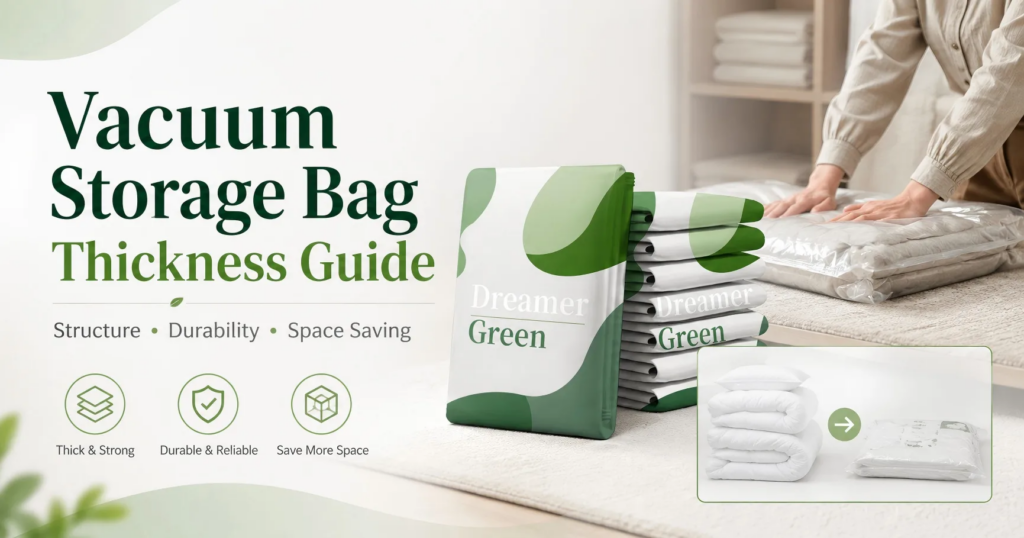
Vacuum storage bag thickness should be evaluated together with film structure, sealing performance, valve design, packed contents, and distribution conditions. A thicker film is not automatically a better bag, and a single thickness figure cannot predict finished-product performance. B2B buyers should define the intended use, request a clear measurement method, compare approved samples, and test the complete bag before confirming a sourcing specification.
Quick Answer
Vacuum storage bag thickness should be evaluated together with film structure, bag size, seals, zipper, valve, packing method, and intended handling. A higher nominal thickness does not by itself guarantee better performance. B2B buyers should define how thickness is measured, compare traceable finished samples, and approve inspection requirements for the complete bag.
Why Thickness Matters in B2B Sourcing
Vacuum bag film thickness affects how a vacuum storage bag feels, folds, seals, prints, and responds to handling. It can also influence material consumption, packing volume, and the buyer’s cost target. However, these effects depend on the complete construction. Two bags described with a similar nominal thickness may perform differently because their material structures, layer balance, closures, valves, dimensions, and converting quality are different.
For importers and private-label brands, the practical objective is not to select the largest number. It is to establish a repeatable vacuum storage bag specification that fits the product claim, retail position, expected contents, and supply-chain risks. That specification should be understandable to purchasing teams, production teams, inspection providers, and customer-service teams. Buyers can also review how ClearNest Pack supports sourcing and customization before defining project responsibilities.
Thickness Is Only One Part of Film Performance
Vacuum storage bags are commonly discussed in terms of total film thickness, but buyers also need to understand what that total represents. A multilayer structure may combine materials that contribute different properties. The structure and converting process can affect flexibility, clarity, resistance to handling damage, and the quality of heat-sealed areas.
A sourcing discussion should therefore separate three questions: what material structure is proposed, what nominal thickness is being quoted, and how the finished bag will be evaluated. Keeping these questions separate helps prevent a supplier comparison from becoming a spreadsheet exercise based on one number.
Nominal Values and Actual Measurements
A quoted thickness is usually a target or nominal value rather than a promise that every point on every bag will be identical. Buyers should ask where measurements are taken, which instrument and method are used, how results are recorded, and what variation is acceptable for the project. Commercial documents should use consistent units and clearly state whether a figure refers to one film wall, the combined material, or another defined measurement.
Do not compare quotations until each supplier has confirmed the same basis. An apparently lower or higher figure may simply reflect a different measurement convention. Written clarification at the quotation stage is much easier than resolving inconsistent goods after production.
Structure Can Matter More Than a Standalone Number
PA and PE are often discussed when buyers evaluate PA PE vacuum storage bags. In general sourcing conversations, different layers may be selected to support barrier, flexibility, sealing, or processing needs. The exact construction must be confirmed for each program rather than inferred from a product name. Buyers should request a material declaration or agreed specification from the proposed manufacturing partner and avoid turning a general material description into an unsupported performance claim.
How End Use Changes the Thickness Decision
The intended contents and selling channel should guide sample selection. A bag intended for soft seasonal clothing faces different handling conditions from a travel bag that will be rolled, folded, packed into luggage, and repeatedly reopened. Large-format products may also be handled differently from compact retail items. These differences should shape the test plan even when products share a brand and visual design. Our overview of compression bags for clothes and bedding helps connect the intended use to size and specification choices. The confirmed Transparent Vacuum Storage Bags provides context for the formats available for project discussion.
| Buying scenario | Thickness-related concern | What to verify |
|---|---|---|
| Soft clothing storage | Balance of flexibility and handling durability | Finished-bag sealing, closure operation, and performance with representative garments |
| Travel or roll-up use | Repeated folding and concentrated handling | Crease areas, closure usability, and repeat-use sample behavior |
| Large storage formats | Stress around edges, corners, valve, and seal lines | Loaded handling and evacuation using an agreed packing method |
| Printed private-label product | Appearance and print interaction with the selected film | Approved artwork sample, color expectations, registration, and surface quality |
| Ecommerce distribution | Handling through fulfillment and parcel delivery | Product packaging, folded condition, and post-distribution inspection criteria |
This table is a planning framework, not a substitute for project-specific testing. Buyers should choose representative contents and handling steps based on their actual market. If a product is expected to serve several uses, the test set should cover the more demanding realistic conditions rather than only an easy demonstration.
A Better Way to Compare Supplier Proposals
Start with a common request-for-quotation document. Ask each potential supplier to respond to the same fields instead of accepting unrelated product descriptions. Record film structure, nominal thickness, size definition, closure design, valve type, printing, retail packaging, carton configuration, and sample status. Leave unconfirmed fields visibly open rather than filling gaps with assumptions.
Next, obtain samples that can be traced to the quotation. Label each sample and keep notes about its construction and date. A sample that cannot be connected to a written proposal has limited value as a purchasing reference. If changes are made after review, request a revised sample or a documented change list before approval.
Use a Controlled Sample Review
Review appearance and dimensions first, then evaluate function. Check the film for obvious damage, contamination, unintended marks, and inconsistent converting. Operate the closure as the end user would. Examine the valve area and perimeter seals. Pack representative items, remove air using the intended method, and observe the bag through an agreed evaluation period. The duration and acceptance criteria should be decided by the buyer for the project rather than assumed from generic marketing language.
Record failures by location and type. For example, distinguish damage associated with a sharp packed object from leakage around a closure, valve, or seal. This evidence helps production teams investigate the relevant construction or process instead of treating every loss of vacuum as a thickness issue.
Evaluate the Complete Commercial Pack
A well-made vacuum storage bag can still reach the customer in poor condition if folding or packaging creates unnecessary stress. Review the way the product is folded, the accessories included, instructions, retail packaging, and master-carton arrangement. Ecommerce sellers should also consider whether product images and descriptions create expectations that the approved construction can support.
Vacuum Storage Bag Thickness Procurement Checklist
- Define the use case. List intended contents, bag format, evacuation method, reuse expectations, sales channel, and likely handling conditions.
- Standardize the measurement language. Confirm the unit, measurement location, test method, and whether the figure refers to a single wall or another basis.
- Document the material structure. Request the proposed layer description and identify any project requirements that still need confirmation.
- Specify the complete construction. Include dimensions, closure, valve, sealing structure, printing, packaging, and accessories.
- Approve traceable samples. Give approved samples or revisions clear identifiers and retain comparison samples when practical.
- Set functional checks. Use representative contents and define how closure, valve, seals, evacuation, handling, and observation will be assessed.
- Define visual acceptance. Document expectations for clarity, surface appearance, printing, cleanliness, and converting workmanship.
- Align inspection documents. Ensure the purchase order, specification, approved sample, and inspection checklist describe the same product.
- Control changes. Require review before material, structure, component, dimension, or packaging changes are used for an order.
- Keep evidence. Store quotations, specifications, sample approvals, inspection records, and corrective-action communication together.
Common Purchasing Mistakes
Choosing Only by the Highest Thickness
This approach ignores film structure, workmanship, and the finished bag. It can also create unnecessary cost or a product feel that does not match the brand brief. Compare complete constructions against the same functional requirements instead.
Accepting an Undefined Thickness Statement
A number without a unit, measurement basis, tolerance approach, or written material description is difficult to enforce. Ask clarifying questions before comparing price and retain the answers in the approved specification.
Testing an Empty Bag Only
An empty-bag check can reveal some obvious issues, but it does not represent stresses from packed textiles, folding, evacuation, or normal handling. Include representative contents and packaging in the review.
Treating Every Leak as a Film Problem
Loss of vacuum may relate to the closure, valve, seal area, accidental puncture, trapped material, or user operation. Diagnose the location and circumstances before requesting a thickness change. A focused corrective action is more useful than changing a specification without evidence.
Printing, Retail Positioning, and Thickness
Printed vacuum storage bags require the film, ink system, artwork and converting process to be reviewed together. A thickness choice should not be approved separately from print registration, heat sealing, valve placement, folding and the finished retail pack. Buyers should use an approved artwork revision and production-representative sample when appearance is commercially important.
Product feel can also influence retail positioning, but descriptions such as premium, heavy duty or durable should be supported by the approved construction and buyer-defined checks. Compare the complete finished bag and packaging against the target channel instead of using thickness as a substitute for evidence.
Comparing 70 Micron and 80 Micron Options
A 70 micron and an 80 micron option can be compared only when the same measurement basis, material structure, dimensions, closure, valve, packaging and intended handling are documented. Thickness alone does not establish finished-bag durability or leak resistance.
| Buying factor | 70 micron option | 80 micron option |
|---|---|---|
| Commercial fit | May suit programs where flexibility, folded pack size and cost target are important. | May suit programs where the buyer requests a higher nominal thickness for the selected construction. |
| Cost discussion | Compare quotations only against the same bag size, structure and packaging. | The actual cost difference remains project-specific and should be compared on the same basis. |
| Durability review | Review finished bags with representative contents, including seals, zipper and valve area. | Use the same finished-bag conditions; the micron value alone is not a performance claim. |
| Market selection | May be considered for value-oriented or compact retail programs after sample review. | May be considered for a buyer-defined specification or retail position after sample review. |
For either option, record the approved measurement method and complete construction before confirming a production specification.
Frequently Asked Questions
What is the best thickness for a vacuum storage bag?
There is no universal best thickness. The appropriate construction depends on the contents, dimensions, closure and valve design, handling conditions, packaging, target market, and buyer-defined performance checks. Compare finished samples using one documented method.
Does a thicker vacuum bag always resist punctures better?
Thickness may influence handling behavior, but it does not by itself establish vacuum bag puncture resistance. Material structure, converting quality, packed objects, sharp edges, folds, and use conditions also matter. Buyers should evaluate complete bags with representative contents.
How should importers verify a quoted thickness?
Ask the supplier to state the unit, measurement basis, locations, equipment or method, and proposed variation criteria. Align those details with the purchase specification and, when appropriate, the vacuum storage bag quality inspection checklist.
Should every size in a product range use the same film?
Not automatically. A consistent structure may simplify a range, but different formats can experience different stresses and customer use. Review each size or size group against its actual application before approving a common construction.
What should be sent when requesting a custom quotation?
Provide the intended use, dimensions and measurement method, preferred structure if known, closure and valve requirements, printing files or direction, packaging concept, target market, expected order scenario, and required sample or inspection process. Mark undecided items as open for discussion.
Build the Specification Around Evidence
For a dependable sourcing decision, treat vacuum storage bag thickness as one controlled variable within a complete product system. ClearNest Pack can help B2B buyers organize size, material structure, thickness, valve, sealing, printing, and packaging requirements and communicate them with appropriate production teams.
Request a project-focused quotation with your target market, use case, and current specification.