
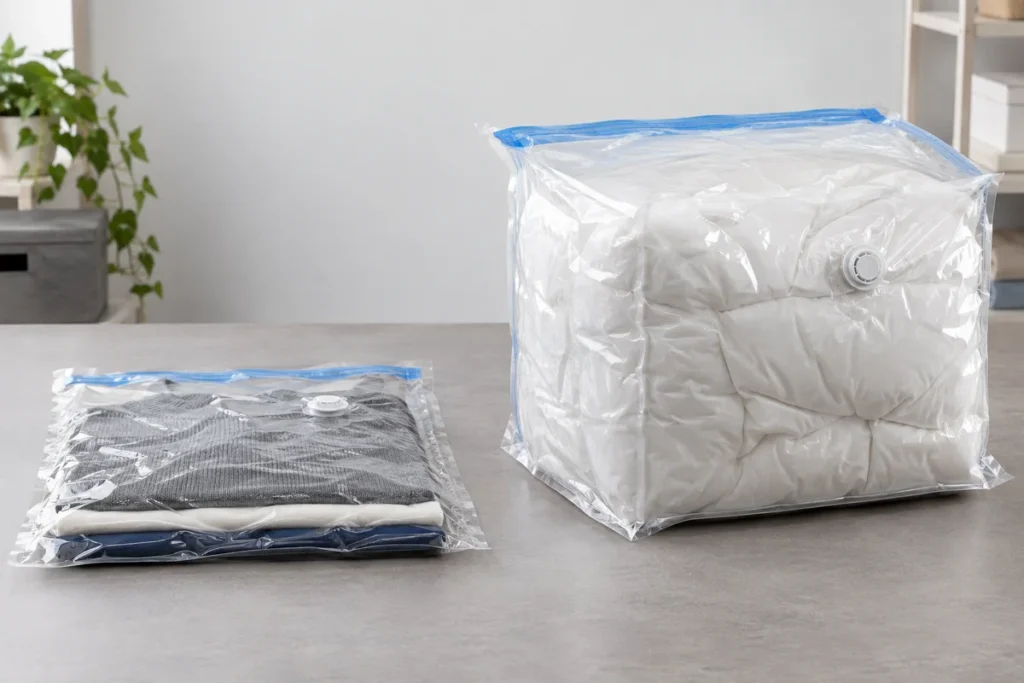
Wholesalers should choose between 3D and flat vacuum storage bags by matching the bag structure to the packed item and retail program. Flat bags suit many clothing and general household applications. A 3D bag adds gusset depth, creating a box-like interior that can be easier to fill with bulky bedding. Neither format is universally better.
The purchasing decision should consider usable dimensions, filling method, zipper and valve position, material, packaging and the way customers will handle the product. Nominal measurements are a starting point; finished samples with representative contents provide the more useful comparison.
What Is a Flat Vacuum Storage Bag?
A flat bag is built primarily from front and back film panels, with a reusable zipper opening, integrated valve and permanent perimeter seals. It is usually supplied and measured by flat width and length. The format folds compactly for retail packaging and can cover a broad range of clothing, sweater, jacket and bedding uses.
Flat bags are straightforward to organize into size families. Buyers can offer repeated core dimensions or build a mixed assortment. The vacuum storage bag sizing guide explains how flat dimensions, sealing allowances and filling practice affect the usable area.
What Is a 3D or Cube-Style Vacuum Storage Bag?
A 3D vacuum storage bag uses a gusset to add depth. When opened and filled, the construction forms a more dimensional interior instead of remaining a simple flat envelope. This can make it practical for folded quilts, comforters, pillows and other bulky textiles that are difficult to distribute evenly inside a flat bag.
The gusset introduces more geometry for the production team to control. Dimensions, folds, perimeter seals, zipper position and valve location must work together. Buyers evaluating 3D vacuum storage bags for wholesale projects should approve the complete finished construction rather than specifying only length, width and depth.
3D vs Flat Vacuum Storage Bags: Side-by-Side Comparison
| Buying factor | Flat bags | 3D gusseted bags |
|---|---|---|
| Bag structure | Front and back panels with a flat opening and perimeter seals | Dimensional format with added gusset depth |
| Typical applications | Clothing, sweaters, jackets and general bedding | Bulky bedding, quilts, comforters and pillows |
| Filling convenience | Works well when contents can be spread across the flat area | Box-like interior can simplify loading stacked bulky textiles |
| Usable internal volume | Depends on flat dimensions, seals, zipper and fill pattern | Depends on all three dimensions plus gusset and seam geometry |
| Packaging | Often folds into a relatively compact retail pack | Additional folds and construction may affect pack presentation |
| Production complexity | Generally fewer dimensional construction points | Gusset alignment and additional geometry require closer review |
| Target buyers | General retailers, apparel programs and household assortments | Bedding distributors, homeware retailers and bulky-storage programs |
| Wholesale review | Compare size mix, film, closure, valve and packaging | Also confirm gusset, filled shape, valve position and carton plan |
Why Gusseted Bags Fit Bulky Bedding
Bulky bedding tends to occupy depth as well as surface area. A gusset allows the bag to open into a more defined three-dimensional shape, which can help a user position folded quilts or comforters before evacuation. That does not prove a specific compression percentage or make the bag immune to leakage.
The packed item still needs to fit without obstructing the zipper or placing concentrated pressure on a corner, valve or seal. Buyers should provide the folded dimensions, weight, compression method and shipping expectations for mattress-sized or unusually bulky projects. Oversized constructions require project assessment rather than an automatic production promise.
When Flat Bags May Be More Appropriate
Flat formats may be the better choice when the range needs familiar dimensions, compact folded packaging or several sizes for clothing and general household use. They can also be easier for customers to understand when the contents spread evenly across the bag.
A retailer can combine smaller clothes formats with larger bedding formats without introducing a gusseted SKU. Review vacuum bags for clothing programs when the assortment is primarily apparel-focused. Transparent flat bags can also simplify visibility and product identification.
Nominal Dimensions vs Usable Storage Capacity
A stated dimension does not equal a rigid internal box. Flat width and length include areas affected by the zipper, permanent seals and the way the bag curves around contents. A 3D measurement adds depth, but gusset folds and seam geometry still influence the usable interior.
Filling method matters as well. Thick folded contents may consume length near the opening, while uneven stacks can create unused space or local stress. Do not publish exact garment counts or blanket capacity unless the claim has been verified with defined contents and the final production-representative bag.
Confirmed 3D Dimensions and Project Review
The current 3D product range displays 70 × 50 × 32 cm, 80 × 56 × 32 cm and 100 × 80 × 32 cm options. These dimensions should be treated as confirmed displayed specifications, not a promise that every size is always stocked or suitable for every item. Availability, MOQ and packaging remain subject to project confirmation.
| Displayed 3D dimension | Buyer review focus |
|---|---|
| 70 × 50 × 32 cm | Intended textile, filled shape, zipper access and retail pack |
| 80 × 56 × 32 cm | Size positioning within the assortment and carton efficiency |
| 100 × 80 × 32 cm | Bulky contents, handling, perimeter seals and valve position |
Custom dimensions can be reviewed, but unusually large formats require assessment of material, gusset structure, seal strength, packed item, evacuation method and outer packing. Buyers should not infer manufacturability from a dimension alone.
Material, Valve, Pump and Sealing Considerations
PA+PE material direction and thickness should be reviewed with the complete bag construction. A thicker number by itself does not establish performance. The film must work with the zipper, valve, gusset folds and permanent seals.
Valve location can influence filling and evacuation, especially on a deep bag. The selected valve should match the intended household vacuum, hand pump or coordinated electric pump. Buyers considering bundled accessories can compare vacuum storage bags with pump configurations.
QC should cover dimensions, gusset alignment, zipper operation, perimeter seals, valve fit and an agreed vacuum-retention method. A 3D format has more dimensional relationships to inspect, but that does not mean it automatically leaks more or less than a flat bag.
Manufacturing and Packaging Implications
Flat and gusseted bags may require different folding, converting and packing plans. A 3D bag’s added geometry can affect production setup, inspection points and how the product sits inside a retail pouch or box. Finished packaging should protect the valve and avoid hard folds that stress the film or seals.
Wholesalers should compare quotations using the same dimensions, material basis, components, printing, pack count and carton assumptions. The wholesale vacuum storage bag page outlines the commercial information needed for a comparable order brief.
Recommendations by Buyer Type
General wholesalers: begin with the applications and sizes that repeat across the customer base. A flat assortment may provide broad coverage, while one gusseted option can address bulky bedding.
Homeware retailers: use packaging and instructions to show the intended item type. Keep the size naming consistent across the shelf range.
Bedding distributors: evaluate 3D samples with representative folded quilts or comforters and confirm handling, valve position and carton packing.
Private-label brands: align construction with the retail story rather than choosing a format only because it appears different. For mixed retail configurations, review the private-label set planning guide.
Wholesale Selection Checklist
- Identify clothing, bedding or mixed-use applications.
- Provide intended contents and folded dimensions.
- Choose flat or gusseted construction based on loading needs.
- Confirm nominal dimensions and measurement method.
- Specify PA+PE material, thickness basis, zipper and valve.
- Confirm evacuation method and any pump included in the set.
- Review printing, retail packaging, folding and carton marks.
- Approve representative samples and written QC criteria.
Frequently Asked Questions
Do 3D vacuum storage bags always hold more than flat bags?
No. Usable capacity depends on the complete dimensions, gusset, seals, zipper, contents and filling method. Compare representative finished samples rather than relying on the format name.
Are 3D bags better for quilts and comforters?
The gusseted shape can make bulky bedding easier to position, but suitability depends on the folded item, weight, dimensions and evacuation method.
Which format is easier to include in a mixed wholesale range?
Flat bags often provide a straightforward multi-size base. A wholesaler may add a 3D bedding format when the customer group has a clear bulky-storage need.
Can 3D vacuum storage bag dimensions be customized?
Custom dimensions can be evaluated. Large or unusual projects require review of material, gusset construction, seals, valve position, packed item, compression method and packaging.
Do 3D bags require a different pump?
Not necessarily. Pump compatibility depends on the selected valve and complete product specification, not only on whether the bag is flat or gusseted.
What should buyers send for a comparison quotation?
Provide the bedding or clothing application, preferred dimensions, quantities by size, material direction, pump method, printing and packaging requirements.
Compare Formats Against the Intended Contents
Planning a wholesale program? Send the intended bedding or clothing application, preferred dimensions, quantity per size and packaging requirements through the quotation form. The suitable flat and 3D production options can then be reviewed against one buyer brief.