
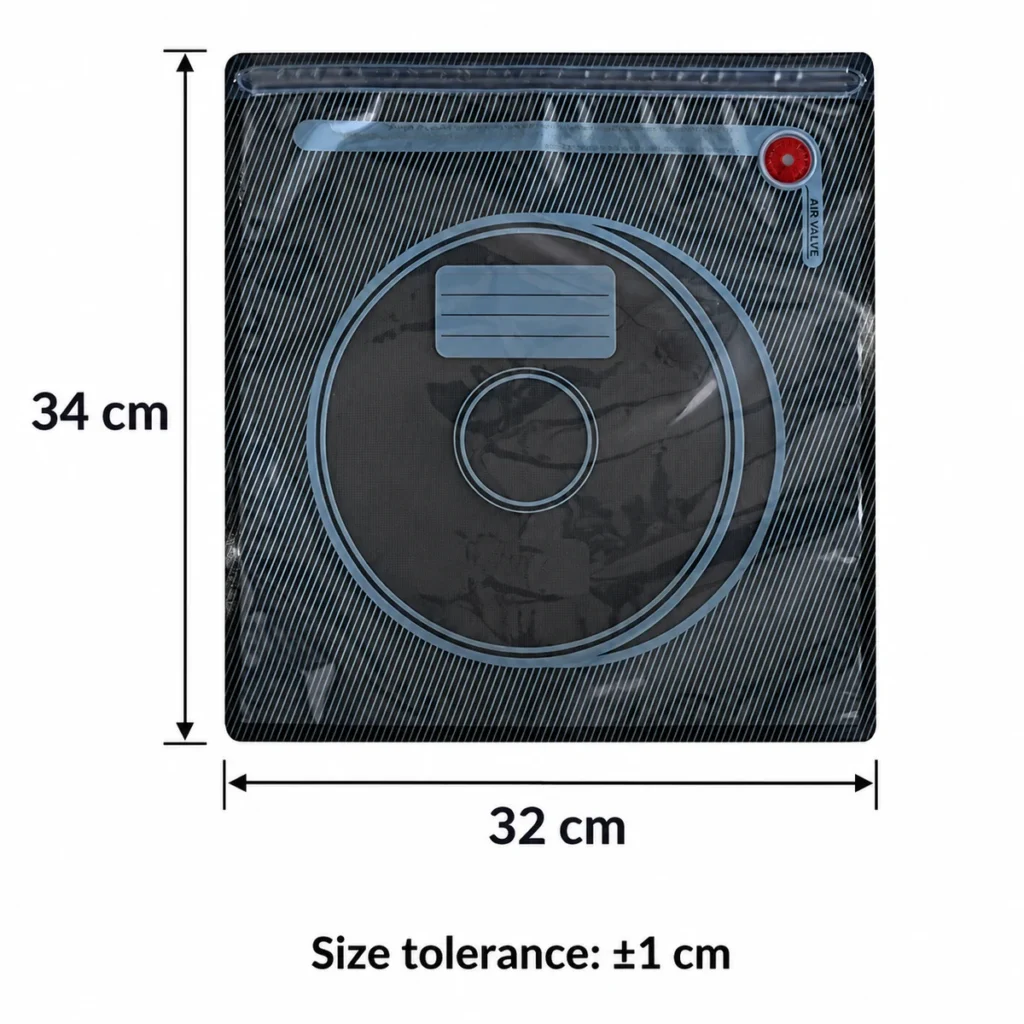
Choosing among 3D filament vacuum bag sizes starts with the physical spool, not only the stated filament weight. Two spools sold as 1 kg can have different diameters, widths, hubs, edge profiles, and labels. A bag must provide usable internal space for the spool while leaving the zipper, valve, and perimeter seals free from stress.
ClearNest Pack’s currently published standard filament vacuum bag is 34 × 32 cm with a ±1 cm tolerance. It uses PA+PE film, a double-track zipper, and an integrated evacuation valve. The listed total film thickness is 0.19 mm for both sides combined. Other dimensions should be treated as custom requirements to review, not as confirmed in-stock standard sizes.
This guide gives individual users a practical measurement method and helps distributors, filament brands, and private-label buyers prepare a size specification before sampling or ordering.
Why Nominal Filament Weight Is Not Enough
Filament weight describes the material on a spool, not the package geometry. Spool designs differ between manufacturers and product lines. A wide spool may need more bag width even when its diameter is modest. A large flange may fit on paper but press against the zipper after the bag wraps around the three-dimensional shape.
Labels, loose filament ends, desiccant sachets, and inserts also consume space. The correct question is not “Will a 1 kg spool fit?” but “Will this exact spool fit inside the usable bag area without loading the closure, valve, or heat seals?”
The Confirmed 34 × 32 cm Reference Size
The existing 3D printer filament vacuum storage bag product page lists 34 × 32 cm with a ±1 cm tolerance. This is the confirmed reference size for the current product. The tolerance matters because production dimensions are not mathematically identical from piece to piece.
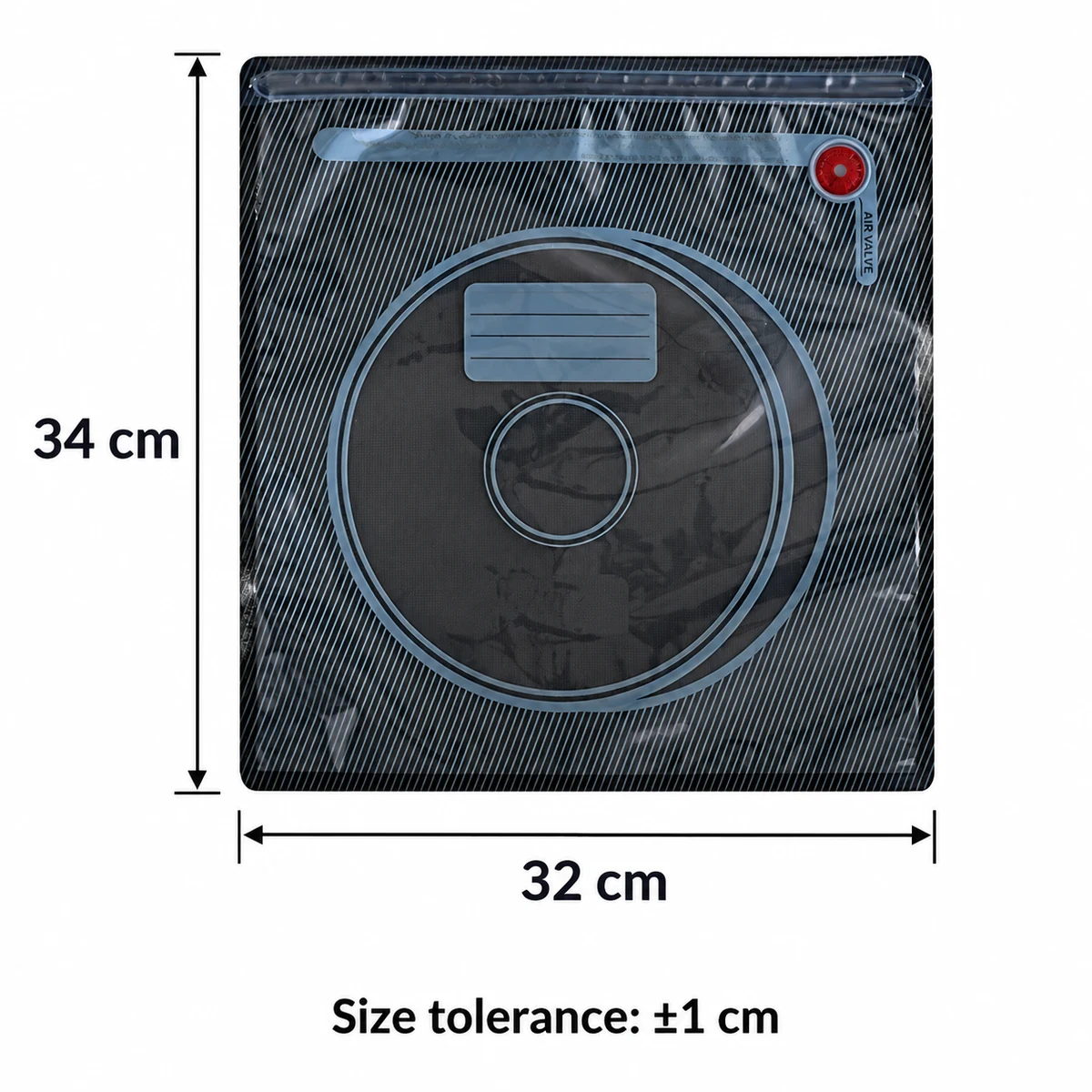
The outside dimensions are not the same as usable internal dimensions. Heat seals, the zipper area, valve placement, and the way the film wraps around a spool reduce the practical space. Buyers should not subtract one generic allowance and assume a fit; they should test actual spools in representative production samples.
Dimensions to Measure on the Spool
| Measurement | How to Measure | Why It Matters |
|---|---|---|
| Maximum flange diameter | Measure across the widest circular edge | Controls the minimum flat span around the spool |
| Overall spool width | Measure outside edge to outside edge | Affects how much film wraps around the sidewalls |
| Hub or center profile | Note protrusions and recessed areas | Can change how the bag conforms under vacuum |
| Edge condition | Inspect for sharp points or damage | Sharp edges increase puncture risk |
| Label and filament tail | Include anything extending beyond the flange | May catch the film or closure |
Measure several samples if a product uses more than one spool supplier or mold. Record the largest and smallest values rather than measuring only one convenient spool. For a retail assortment, build a dimension matrix showing which spool formats must share one bag.
Allow Space for the Zipper
A spool should not sit directly against the double-track zipper. The user needs enough free film to align both tracks, remove wrinkles, run the slider across the complete opening, and inspect both ends. When the spool is too close, the zipper can bow or fold and create an incomplete seal.
Do not solve a zipper-clearance problem by overcompressing the package. Choose a bag that permits normal closure before evacuation. For the correct sealing sequence, use the step-by-step filament vacuum-sealing guide.
Allow Space Around the Valve
The integrated valve needs a reasonably flat area so a compatible manual or electric pump can seat correctly. A spool flange pressing below the valve may prevent an even connection or pull the valve sideways. The valve membrane and bond should remain free from sharp spool edges and loose filament.
During sample review, insert the largest intended spool, close the zipper, and try the exact pump proposed for the kit. A theoretical drawing cannot fully demonstrate how the film, spool, valve, and pump interact.
Account for Film Wrapping Around a 3D Object
A flat bag dimension is measured on an empty bag, while a spool is a thick three-dimensional object. Part of the bag’s width and length wraps around the spool edges. This is why comparing the flange diameter directly with one flat dimension is insufficient.
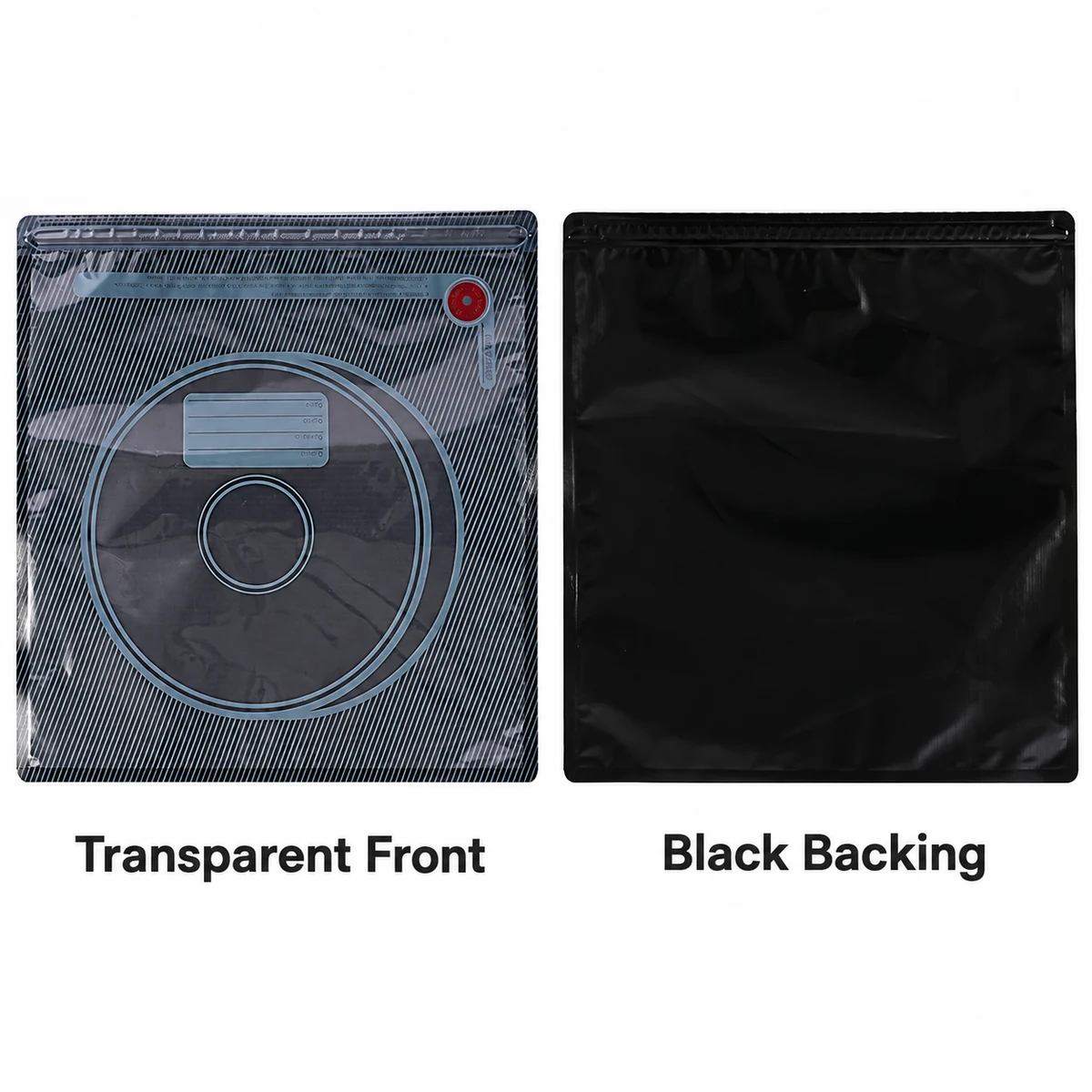
Film stiffness, total construction, seal placement, and evacuation level affect the final shape. ClearNest Pack’s listed construction is PA+PE with 0.19 mm total thickness for both sides combined. That specification should not be converted into a per-side value unless the measurement method and layer structure are confirmed.
Consider Desiccant and Kit Components
A desiccant sachet needs a position where it will not contaminate the zipper, block the valve, or create a hard pressure point. If instructions, labels, or accessories are packed inside the same bag, include them in the fit trial. Do not assume they occupy negligible space.
Manual pumps and USB electric pumps are normally packed as separate kit components rather than inside every sealed spool bag during use. For retail packaging, define how many bags, sachets, pumps, sliders, and instruction sheets belong in each sales unit. This outer packaging calculation is separate from choosing the bag body size.
Standard Bag Size vs Custom Bag Size
| Decision Area | Standard 34 × 32 cm Reference | Custom Dimension Project |
|---|---|---|
| Starting point | Published existing specification | Buyer-provided spool and target dimensions |
| Fit validation | Still required with actual spools | Required before approval |
| Construction | PA+PE, double-track zipper, integrated valve | Reviewed against project requirements |
| Commercial terms | Standard non-custom bags-only MOQ is currently listed from 1,000 pcs; custom logo printing MOQ is 30,000 pcs | MOQ and timing require separate confirmation |
| Packaging | Can be quoted separately | Defined independently from bag-body changes |
A custom size is appropriate when target spools do not fit safely, a brand uses an unusual reel, or a kit needs a particular presentation. Do not describe an unapproved custom dimension as a standard stock item. Confirm dimensions, tolerance, material, thickness basis, zipper, valve location, sample process, MOQ, and production timing in writing.
Bag-Body Customization vs Retail Packaging Customization
Bag-body customization changes the item that encloses the spool. It can include dimensions, film structure, thickness, zipper, valve, writable area, or printing on the bag. These changes can affect tooling, validation, quantities, and lead time.
External packaging customization changes how bags and accessories are presented for sale or shipment. It can include labels, instruction cards, barcodes, poly bags, retail boxes, master cartons, and shipping marks. A buyer can sometimes keep the standard bag body and customize only the outer package. Conversely, a custom bag size does not automatically include custom retail packaging.
Separate these scopes in the request for quotation. For the currently published standard non-custom bags-only configuration, the product page lists a 1,000-piece MOQ. Custom logo printing on the bag body has a 30,000-piece MOQ. Custom dimensions, pump kits and private-label outer packaging require separate written confirmation. A logo printed on the bag itself is a different production scope from branding on an outer retail bag or box. For commercial planning, consult the existing wholesale filament vacuum bag guide.
Sample Fit-Test Procedure
- Collect the smallest and largest actual spools intended for the program.
- Measure diameter, width, protrusions, labels, and edge condition.
- Insert each dry spool into a representative bag without forcing it.
- Check free space at both zipper tracks and the zipper ends.
- Position the proposed desiccant without blocking the valve or closure.
- Seal both zipper tracks and attach the exact proposed pump.
- Evacuate to a practical level and inspect film stress around spool edges.
- Check the valve bond, heat seals, corners, and package stability.
- Repeat opening and resealing according to the intended user routine.
- Document the approved spool models, bag sample, and kit components.
A sample that fits one spool does not prove universal compatibility. If the selling claim covers several brands or weights, test a representative range. Avoid stating that the bag fits “all 1 kg spools” unless the claim is supported by a defined compatibility program.
Size Planning for Distributors and Brands
Using one bag size for many spools simplifies inventory, packaging artwork, and customer instructions, but an oversized bag can look loose and use more material. Multiple sizes can improve fit but add SKUs, forecasts, labels, cartons, and inspection requirements. Choose the smallest practical assortment that safely covers the verified spool range.
Create a compatibility chart for customer service and listings. Identify the tested spool dimensions rather than naming only filament weight. If selling a mixed kit, specify bag count, desiccant count, pump count, retail unit quantity, barcode, instruction language, and master-carton arrangement.
Storage bags should not be presented as filament dryers. The companion guide explaining how vacuum bags protect dry filament can support accurate customer education.
Buyer Checklist Before Approving a Size
- Actual maximum spool diameter and width
- Required spool families and compatibility range
- Bag outside dimensions and production tolerance
- Usable closure and valve clearance
- Material structure and thickness measurement basis
- Zipper, slider, valve, and pump compatibility
- Desiccant position and accessory count
- Bag-body customization requirements
- External retail packaging and carton requirements
- Approved sample and inspection criteria
- MOQ, timing, artwork, and documentation requiring confirmation
Frequently Asked Questions
What is the standard ClearNest Pack filament vacuum bag size?
The currently published standard size is 34 × 32 cm with a ±1 cm tolerance.
Does a 34 × 32 cm bag fit every 1 kg spool?
No universal fit is promised. Measure the actual spool diameter and width and test clearance at the zipper and valve.
Are other filament bag sizes available from stock?
No other dimension should be treated as a confirmed stock standard without written confirmation. Custom dimensions can be reviewed as project requirements.
Should bag size be based on spool weight?
No. Use the spool’s maximum diameter, total width, protrusions, and required closure clearance. Nominal filament weight alone is insufficient.
Does adding a desiccant sachet change the required size?
It can. The sachet needs space away from the zipper and valve and should not create a hard pressure point against the film.
Is custom retail packaging the same as a custom bag size?
No. Bag dimensions change the product body, while labels, instruction cards, retail bags, boxes, and cartons are external packaging work.
What should a buyer send for a custom-size review?
Send spool diameter and width, physical samples where practical, order quantity, bag construction needs, pump choice, accessory list, packaging scope, and destination.
Conclusion
The right filament vacuum bag size is the one that fits verified spools without loading the zipper, valve, film, or perimeter seals. Use 34 × 32 cm as the current confirmed ClearNest Pack reference, not as a universal fit claim. Measure real spools, test the complete bag-pump-accessory system, and separate bag-body changes from retail packaging work. Buyers can request a size and kit review with their spool dimensions, quantity, pump preference, and packaging requirements.