
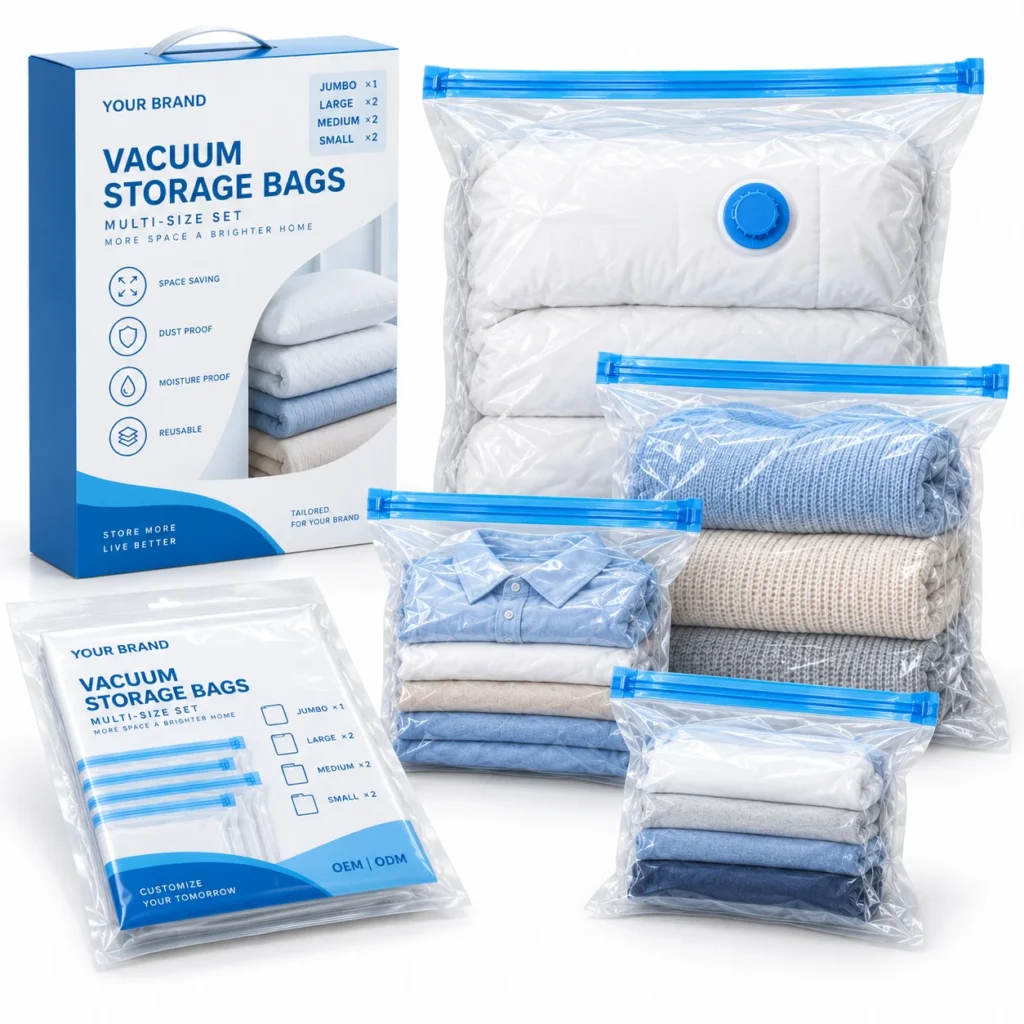
Private label vacuum storage bag sets should be planned from the selling unit backward. An Amazon seller first needs to decide what the customer receives, which sizes belong together, whether a pump is included, and how the complete set will be packed and identified. Those decisions affect the bag specification, carton plan, shipping weight, artwork, quality checks and quotation.
A useful development brief does not begin with “make a 12-piece set.” It describes the target household use, intended retail position, destination marketplace, size mix, pump preference, packaging format and estimated order volume. The factory can then evaluate whether the proposed configuration is practical and what must be confirmed before production.
That discipline also makes later quotation comparisons more consistent and useful.
Why Set Configuration Matters for Online Sellers
Online shoppers evaluate a bundle as one product, but production teams build it from several components. A set may contain different bag dimensions, repeated sizes, a hand pump, an electric pump, instructions, labels and a retail box. If one component changes, the package dimensions, pack count and product presentation may also change.
For sellers, a larger piece count can look attractive in a listing, yet it is not automatically the better commercial choice. More pieces can increase packing labor, shipping weight and the chance of a counting error. A smaller, clearly defined assortment may be easier to explain and replenish. The right choice depends on the target use and channel, not on piece count alone.
Individual Bags vs Multi-Piece Retail Sets
Individual bags give buyers flexibility when they already know the required dimension. They can also suit refill programs or wholesale customers that purchase by size. Multi-piece sets are designed around several household tasks, such as clothing, sweaters and bedding, and can provide a more complete retail proposition.
A seller considering private-label vacuum storage bags should define whether the set is a general household assortment, a travel kit or a bedding-focused bundle. Mixing unrelated applications can make the packaging harder to explain and may add sizes that customers do not expect to use.
Planning 10-, 12-, 15- and 20-Piece Sets
The following configurations are planning examples, not confirmed factory SKUs. They show how a buyer might distribute quantities across sizes. Every dimension, count, pump and packaging format must be reviewed for the actual project.
| Illustrative set | Example planning logic | Questions to confirm |
|---|---|---|
| 10-piece | Two or three core sizes with repeated quantities | Is the assortment aimed at clothing, bedding or mixed household use? |
| 12-piece | A balanced small, medium and large mix, with or without a pump | Does the added size improve usefulness enough to justify packaging space? |
| 15-piece | Several repeated flat-bag sizes for a broader household set | Can each size be identified clearly on the bag, insert and listing? |
| 20-piece | A high-count assortment built from repeated core sizes | How will piece count affect box dimensions, shipping weight and QC? |
For example, a 10-piece concept might use four medium, four large and two extra-large flat bags. A 12-piece concept might divide evenly among three sizes. A 15-piece concept could emphasize medium and large formats while retaining a smaller quantity for bulky bedding. These are illustrations only. Buyers should use the vacuum storage bag size guide to define dimensions before assigning quantities.
Bag-Only, Hand-Pump and Electric-Pump Sets
Bag-only sets may suit customers who already own a compatible vacuum cleaner or pump. They reduce the number of components that must be sourced and packed, but the listing and instructions should explain the intended evacuation method.
A hand pump can support travel or portable-use positioning and avoids destination plug questions. It also adds physical volume to the retail pack. Electric-pump sets may provide a different user proposition, but pump model, nozzle fit, voltage, plug and destination-market requirements must be confirmed. ClearNest Pack manufactures the bags and coordinates compatible pump options; this does not mean the factory manufactures the electric pumps.
Review vacuum storage bags with compatible pump options when comparing complete set directions. Compatibility should be evaluated with the selected integrated valve and finished bag rather than assumed from a general pump description.
Private-Label Packaging and Artwork
Packaging needs to identify the contents accurately. The retail box or pouch should show the included bag sizes, quantity per size, pump contents, operating steps and any buyer-approved warnings. Instruction inserts can clarify zipper closure, valve use, suitable contents and storage precautions.
Logo placement, color artwork, barcodes, SKU labels and marketplace identifiers need controlled files and approval. A barcode supplied by the buyer should be checked against the intended product variation; the factory should not invent marketplace identifiers. Sellers can review printed vacuum storage bag options when deciding whether branding belongs on the bags, the packaging or both.
Retail boxes, inserts and labels are available depending on order specifications. Packaging artwork should not be released until the final set count, dimensions and pump direction are stable because those choices affect both copy and physical pack size.
Cost, Shipping Weight and Margin Considerations
A meaningful quotation separates the decisions that influence cost. Bag dimensions and film use matter, but so do printing coverage, number of SKUs, packaging material, pump type, insert count, assembly work and carton configuration. A high-count set may reduce the apparent cost per piece while increasing the delivered cost of the complete retail unit.
Sellers should model product cost, packaging cost, freight, marketplace fees, storage, returns and promotional allowances with their own current data. No supplier can guarantee a margin without knowing those inputs. Compare quotations against the same approved configuration so one proposal does not omit components included in another.
Sampling, Quality Control and Production Planning
Sampling should answer specific questions. A reference sample may help review film, zipper or valve direction, while a custom sample may be needed to evaluate dimensions, printing or a new pack. The approval record should state which elements are final and which remain provisional.
Quality checks for a multi-piece set can include bag dimensions, visible film condition, zipper operation, valve fit, permanent seals, printing, piece count, pump compatibility, inserts, barcode placement and finished packaging. Functional criteria should be agreed for the actual SKU. The vacuum storage bag manufacturing capabilities provides context for production and QC capability.
Production planning should account for artwork approval, component availability and the number of variations. Buyers developing nonstandard sizes or structures can discuss custom vacuum storage bag specifications before locking the set.
Amazon Marketplace Requirements Are the Seller’s Responsibility
Marketplace rules, labeling requirements, listing fields, packaging restrictions and fulfillment fees can change. Sellers should verify current Amazon requirements for their marketplace and fulfillment method before approving artwork or cartons. Factory review can help align manufacturing files with the buyer’s instructions, but it does not constitute Amazon approval or legal advice.
Do not place unsupported performance claims, compliance marks or guaranteed compression results on packaging. Claims should be based on evidence for the exact product and reviewed by the brand owner for the destination market.
New-Product Planning Checklist
- Define the target marketplace, customer use and retail position.
- Select the bag dimensions and quantity per size.
- Choose bag-only, hand-pump or electric-pump direction.
- Confirm valve compatibility and destination plug requirements.
- Specify PA+PE construction, thickness basis, zipper and seals.
- Define printing, box or pouch, inserts, labels and barcodes.
- Estimate order volume by SKU and required launch timing.
- Approve traceable samples, artwork and packaging files.
- Agree QC checks for bags, pumps, counts and finished sets.
- Verify current marketplace and fulfillment requirements independently.
For bedding-focused bundles, compare flat and gusseted formats in the 3D versus flat vacuum storage bag guide before finalizing the assortment.
Frequently Asked Questions
What set size is best for a new Amazon listing?
There is no universal best count. Choose a configuration that matches the intended use, price position, shipping plan and customer expectations, then test whether every included size has a clear purpose.
Can different vacuum bag sizes be packed in one set?
Yes, mixed-size sets can be reviewed. The buyer should confirm dimensions, quantity per size, labels, instructions, packaging and the method used to verify the final piece count.
Can a hand pump or electric pump be included?
Compatible options can be coordinated depending on the bag valve and project. Electric-pump model, voltage, plug and destination-market requirements must be confirmed before production.
Can the bags and retail box carry a custom logo?
Custom printing can be reviewed for both bags and packaging. Artwork, colors, print area, barcode files and approval method need to be agreed for the order.
Does ClearNest Pack guarantee Amazon approval or sales?
No. The seller is responsible for current marketplace, labeling and legal requirements. Manufacturing support does not guarantee listing approval, ranking, margin or sales performance.
What should buyers provide for a quotation?
Share the marketplace, bag dimensions, quantity per size, pump preference, packaging direction, estimated order volume, artwork status and target schedule.
Prepare a Set Brief Before Requesting a Quote
Planning a private-label set? Send your target marketplace, intended piece count, bag dimensions, pump preference, retail positioning, estimated order volume and packaging design requirements through the existing quotation form. We can review suitable production options without assuming an unconfirmed SKU or marketplace requirement.