
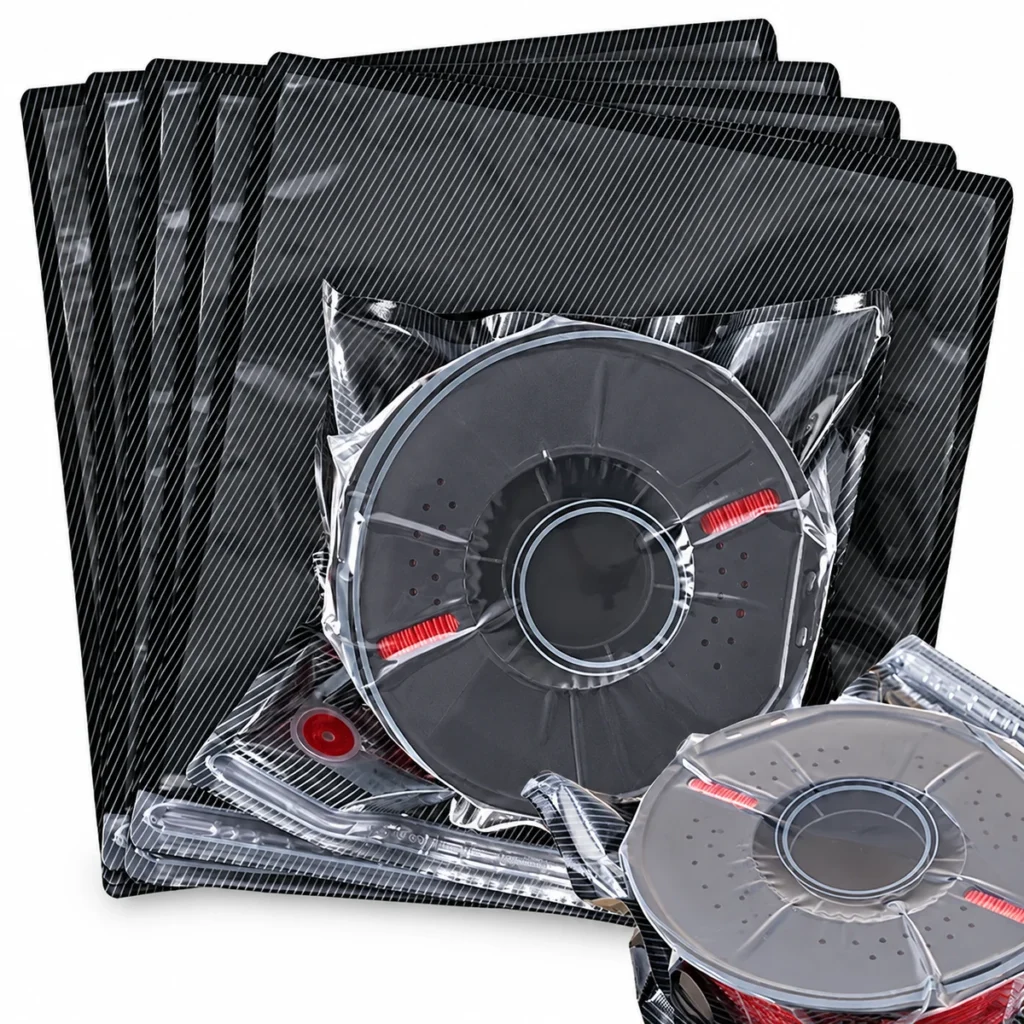
Reusable filament vacuum bags and single-use barrier pouches solve different packaging problems. A reusable bag is designed to be opened, closed, and evacuated again as a spool moves between storage and printing. A single-use pouch is normally sealed for distribution and opened once by the customer. Neither format is automatically better: the right choice depends on who handles the spool, how often it is accessed, whether a pump is part of the offer, and what level of packaging validation the buyer can support.
This guide explains the decision from a distributor, filament brand, and private-label buyer’s perspective. Vacuum packaging cannot dry wet filament or guarantee a fixed protection period. Performance depends on the complete package and its handling.
Two Packaging Formats with Different Jobs
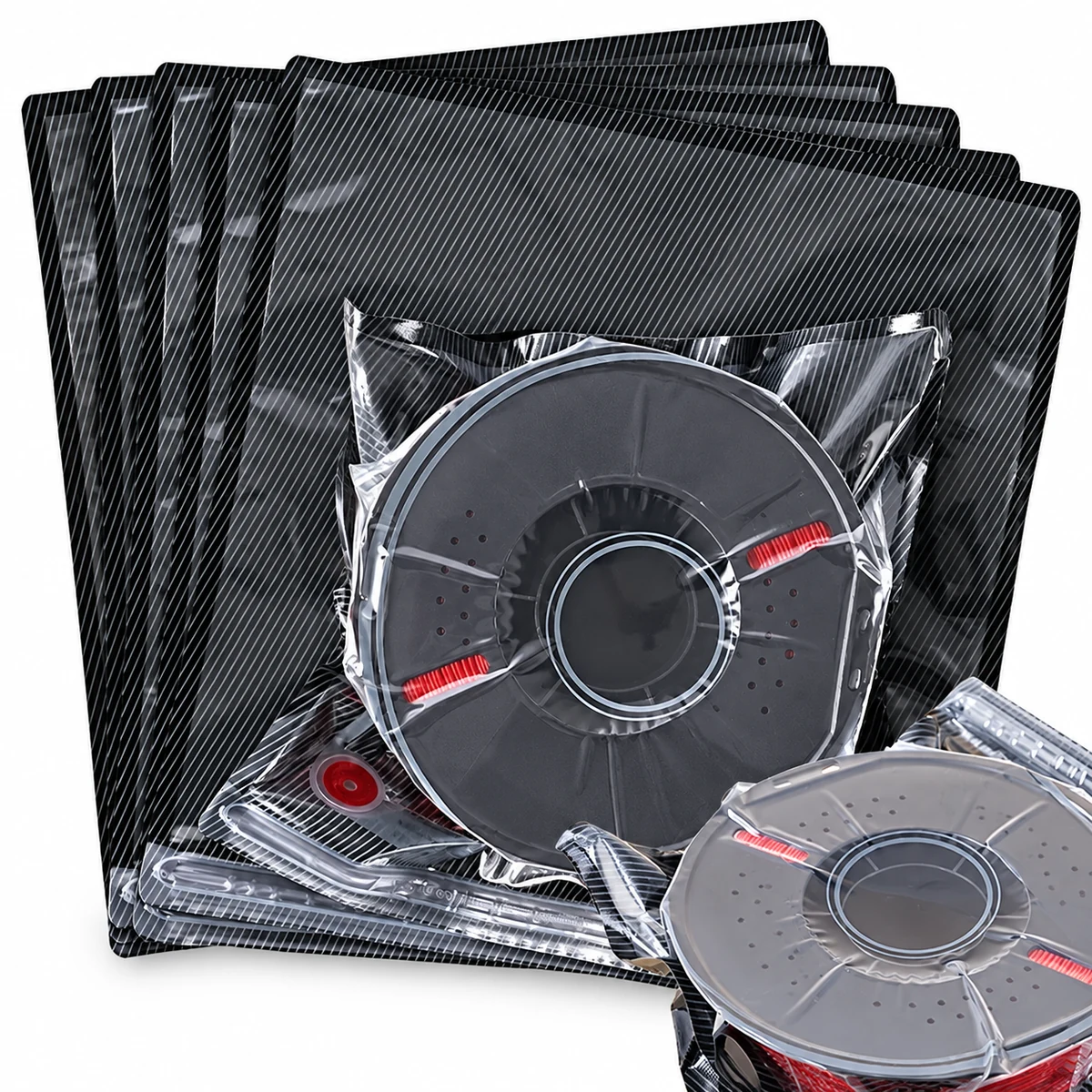
A reusable filament vacuum bag typically has a resealable zipper and an evacuation valve. The user returns the spool, closes the zipper, and uses a compatible pump to remove excess air. The closure and valve need to remain functional through the intended handling cycle.
A single-use filament pouch is usually sealed during packing and cut or torn open by the user. Depending on the project, it may be evacuated, flushed, or simply heat sealed. “Single-use” describes the intended opening method; it does not by itself prove a particular barrier performance. Buyers must confirm the actual material structure, seal design, and supporting data for the offered pouch.
How the formats differ in use
| Decision point | Reusable evacuation bag | Single-use sealed pouch |
|---|---|---|
| Opening pattern | Repeated access to the same spool | Opened once for initial use |
| Closure | Resealable zipper plus valve | Permanent production seal, often without a reusable zipper |
| User equipment | Compatible manual or electric pump may be required | No pump is normally needed after opening |
| Typical role | Storage accessory or reusable kit | Factory or retail distribution packaging |
| Key validation | Zipper, valve, pump fit, and repeated handling | Film structure, production seal, opening method, and packing process |
A pouch with weak seals is not improved simply by calling it single-use, and a resealable bag is not indefinitely reusable. Both formats require an approved sample and a defined use case.
Where Reusable Filament Vacuum Bags Fit
Reusable bags are well suited to makers, workshops, educational labs, and customers who rotate among several open spools. They also work as an aftermarket accessory sold by filament distributors or printer retailers. A kit can combine bags with compatible pumps, desiccant sachets, instructions, and external retail packaging.
ClearNest Pack’s current 3D printer filament vacuum storage bag is a reusable PA+PE design measuring 34 × 32 cm with a ±1 cm tolerance. The stated 0.19 mm thickness is the total for both sides combined. It uses a double-track zipper and integrated air valve, with compatible manual-pump and USB electric-pump options. Fit is not promised for every 1 kg spool; actual spool diameter and width must be checked.
For end-user instructions, the filament vacuum-sealing guide explains zipper closure, pump positioning, desiccant use, and leak checks.
Handling and maintenance
Repeated opening introduces handling risks. Dust, filament fragments, or desiccant granules can interrupt the zipper tracks. Sharp spool flanges can mark the film. Pulling the pump sideways can load the valve, and excessive evacuation can stretch the bag around hard edges.
Customer instructions should therefore explain how to clean and align both zipper tracks, protect the valve, avoid punctures, and inspect the bag before reuse. A bag with damaged film, a loose valve, or distorted seals should be replaced. “Reusable” should not be presented as an unlimited-life claim.
Single-Use Pouches: A Separate Packaging Project
A single-use sealed pouch can suit a spool packed once at the factory and opened by the customer. There is no zipper or pump to operate before first use, and the surface can carry product information.
However, the manufacturing and verification scope is different. Buyers should specify the film structure, pouch dimensions, heat-seal area, opening method, print requirements, desiccant, label information, and outer carton. If a vacuum or gas-control process is required, the packing equipment and acceptance criteria also need confirmation.
ClearNest Pack’s published filament product is a reusable zipper-and-valve bag. The company has not published or confirmed a standard single-use heat-sealed filament pouch offer. The single-use format is discussed here only as a packaging category. Any such request would require separate feasibility, specification, MOQ, sample, and production confirmation.
Bag-Body Customization and Retail Packaging Are Separate
Changing the bag body means changing dimensions, material structure, thickness, zipper, valve, seals, or printing on the bag itself. External packaging covers items such as labels, instruction cards, barcodes, retail poly bags, boxes, and master cartons. A buyer may use a standard reusable bag with custom outer packaging, or request a custom pouch construction with simple bulk packing.
Keep these scopes separate in the quotation. MOQ, sampling, artwork approval, and timing can differ between the bag and the external package. The wholesale filament vacuum bag buying guide provides a broader checklist for kit contents, pumps, packaging, and supplier comparison.
What Buyers Should Test Before Choosing
- Spool fit: Measure maximum flange diameter and total spool width. Use the filament vacuum bag size guide to plan zipper and valve clearance.
- Initial filament condition: Pack dry filament. Vacuum storage does not remove moisture already absorbed by the polymer.
- Closure behavior: For reusable bags, check both zipper tracks after repeated opening. For single-use pouches, approve the production seal and opening method.
- Valve and pump compatibility: Test the exact valve with the proposed manual or electric pump rather than assuming a universal fit.
- Handling: Observe contact with spool edges, labels, desiccant, and retail components.
- Claims and evidence: Do not assign a fixed storage duration without a relevant test method and supporting results.
For a clear explanation of what vacuum bags can and cannot do, see how vacuum bags protect dry filament.
A Practical Choice by Sales Scenario
A reusable pump kit fits retailers that sell a storage accessory customers can use across several spools. Bags-only packs suit buyers whose customers already own a compatible pump. A filament manufacturer shipping a newly produced spool may evaluate a single-use pouch when repeated access before sale is not required. A brand can also combine both ideas: sealed primary distribution packaging plus a separate reusable storage accessory, provided the two products and their claims are clearly distinguished.
Compare more than the bag price. Reusable programs may add pumps, sliders, and instructions; single-use programs may require different sealing equipment, production controls, and printed pouch development.
Questions to put in the supplier brief
- Is the project a reusable storage accessory or primary distribution packaging?
- Which spool dimensions must fit, and which samples will be supplied?
- What film structure and thickness measurement basis are proposed?
- What zipper, valve, pump, or permanent seal is required?
- Will desiccant be included, and where will it sit?
- Which items belong to the bag body and which belong to retail packaging?
- What sample checks and production acceptance criteria will be used?
- Which performance claims are supported, and which remain unverified?
Frequently Asked Questions
Are reusable filament vacuum bags better than single-use pouches?
Not for every purpose. Reusable bags support repeated spool access, while single-use pouches can suit one-time factory or retail packing. Choose according to the handling process and validate the actual specification.
Can a reusable bag be opened indefinitely?
No. Reuse depends on the condition of the film, zipper, valve, and seals. Inspect the bag each time and replace it when damage or unreliable sealing appears.
Does either format dry wet filament?
No. Filament that has absorbed moisture needs an appropriate drying process. Packaging helps limit later exposure; it is not an active dryer.
Does the 34 × 32 cm reusable bag fit every 1 kg spool?
No universal fit is claimed. Spool diameter and width vary, so buyers should measure actual spools and approve samples with adequate zipper and valve clearance.
Can the bag logo and the retail package both be customized?
They are separate scopes. Bag-body printing and construction must be specified independently from labels, instructions, boxes, barcodes, and master cartons.
Choose around the real handling process. The useful distinction is not “reusable good, single-use bad” or the reverse. It is whether the package matches how the spool is produced, sold, opened, stored, and used. Define the spool, film, closure, valve or seal, pump, desiccant, packaging, and verification steps before comparing quotations. Buyers planning a reusable bags-only or pump-kit program can request a filament storage packaging review with spool dimensions, quantities, accessories, and retail packaging requirements.