
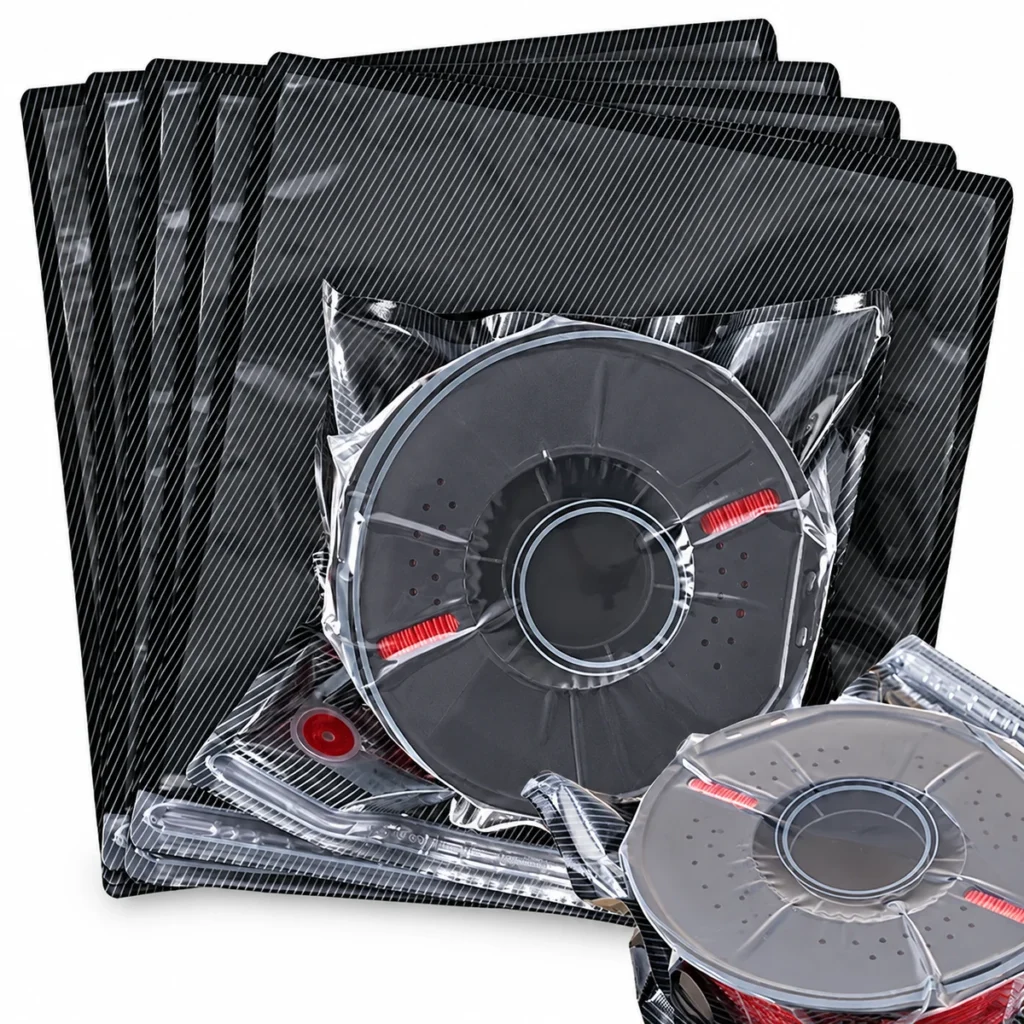
PETG filament storage works best as a two-stage process: dry the material when it has absorbed moisture, then protect the dry spool from renewed exposure to humid air. A sealed container or vacuum bag can support the second stage. It cannot perform the first one, because removing air around a spool does not reliably remove water already absorbed inside the polymer.
The practical routine depends on the PETG formulation, local humidity, spool design, printing schedule, and the filament producer’s instructions. There is no responsible universal drying temperature, drying time, or sealed-storage duration for every PETG product.
Why PETG Storage Needs More Than a Closed Cardboard Box
PETG is hygroscopic: it can take up moisture from surrounding air. The rate and effect vary with formulation, additives, temperature, humidity, exposure time, and packaging. A spool may look normal while its printing behavior changes.
Popping, bubbles, increased stringing, rough surfaces, or inconsistent extrusion can be associated with moisture, but none of these symptoms proves moisture on its own. Retraction settings, nozzle condition, temperature, and material quality can create similar results. Comparing with a correctly dried sample is more useful than diagnosing only from appearance.
Original retail packaging may protect an unopened spool when its seals and barrier structure are intact. Once opened, a cardboard box alone does little to control the air surrounding the filament. The spool should return to a controlled enclosure after use.
Drying and Sealed Storage Are Different Operations
Drying uses controlled heat and airflow, or another process specified by the filament manufacturer, to remove absorbed moisture. Sealed storage limits new exposure after the material is dry. Treating these operations as interchangeable leads to poor results: sealing a wet spool simply encloses wet material.
Follow the PETG supplier’s instructions for the exact product and spool. Avoid copying a temperature and time from an unrelated formulation. Excessive heat can deform a plastic spool or affect the filament, while insufficient treatment may not correct the problem. Let a dried spool reach a suitable packing condition before sealing it; placing a hot spool directly into a cool package can create unwanted temperature and condensation effects.
The broader filament storage comparison explains how vacuum bags, airtight containers, and dry boxes serve different roles.
Choosing a Storage Method for PETG
| Method | Best use | Limitation to remember |
|---|---|---|
| Resealable original package | Short-term storage when the original barrier and closure remain sound | Damage or incomplete resealing reduces protection |
| Airtight container with desiccant | Frequent access to one or more spools | Uses more space and must be opened to reach the contents |
| Reusable vacuum bag | Compact storage of a dry spool between uses | Requires correct spool fit, zipper closure, valve, and pump compatibility |
| Dry box used during printing | Material that needs controlled handling while feeding the printer | Equipment capability and settings vary; follow its instructions |
A workshop may use more than one method. A dry box can manage a spool during printing, while a vacuum bag or sealed container protects other dry spools in storage. The right choice depends on access frequency, available space, and the degree of control required.
Using a Vacuum Bag for PETG
Start with a dry spool and a clean, undamaged bag. Measure the spool’s maximum flange diameter and total width rather than assuming every “1 kg” spool has the same geometry. Leave enough free film for the zipper to lie flat and for the pump to seat on the valve without pressing against the spool.
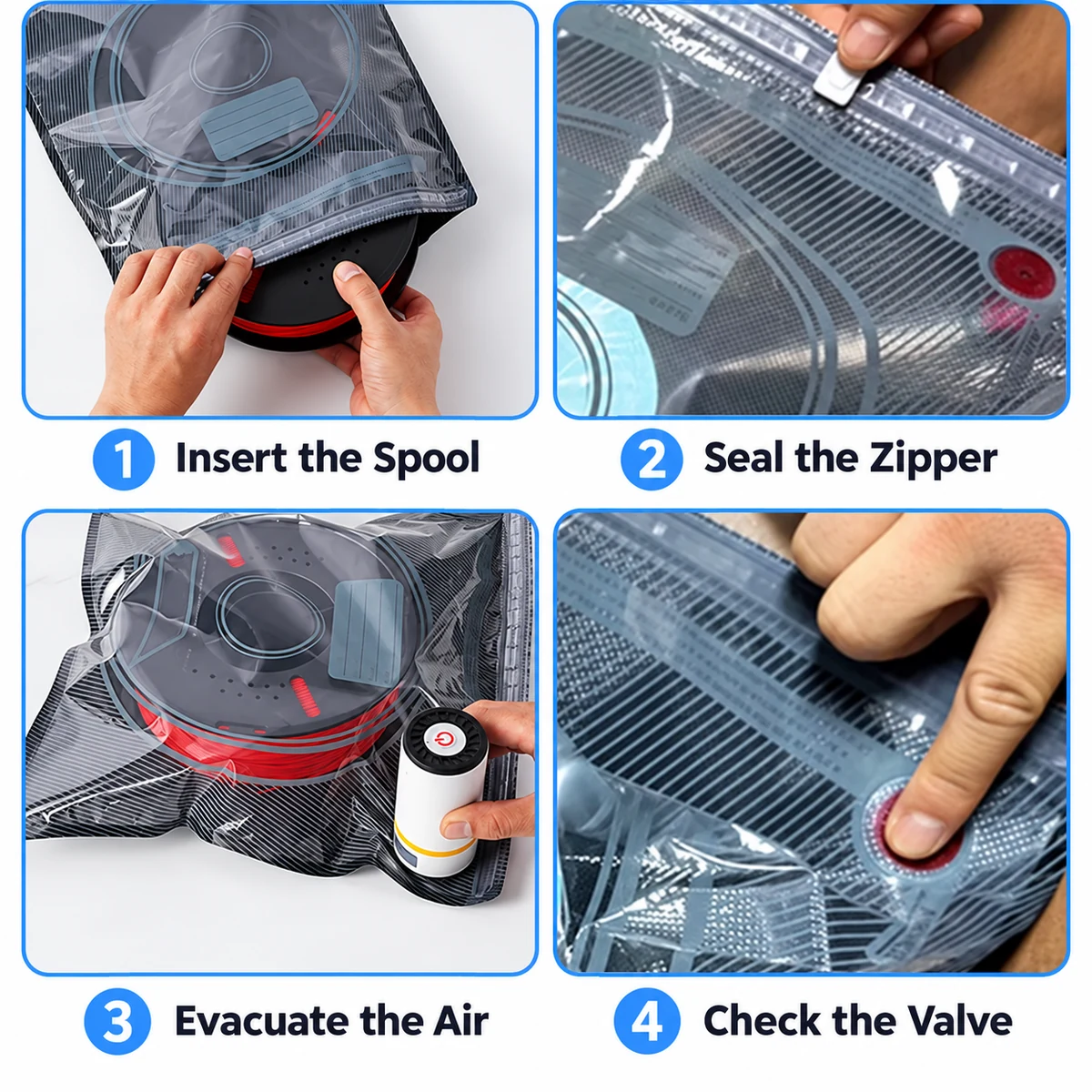
- Inspect the film, perimeter seals, zipper tracks, and valve.
- Insert the dry PETG spool without dragging sharp flange edges across the film.
- Add a dry desiccant sachet where it will not contaminate the zipper or block the valve.
- Close both zipper tracks across the full width and check both ends.
- Seat a compatible manual or electric pump squarely on the valve.
- Remove excess air without stretching the film sharply around the spool.
- Label the package with material, color, spool identity, and packing date.
The detailed vacuum-sealing procedure for filament covers pump positioning, closure checks, and common mistakes. If a package visibly reinflates, inspect it systematically rather than assuming that a stronger pump will fix the problem.
What Desiccant Can and Cannot Do
Dry desiccant helps manage residual humidity inside a sealed package and small amounts of moisture entering during normal handling. It does not repair a puncture, close a contaminated zipper, or dry a seriously moisture-laden spool. Its type, quantity, condition, indicator system, and replacement guidance should match the storage plan.
Keep loose particles away from zipper tracks and the valve. For retail kits, define the number of sachets per sales unit and provide instructions that do not imply unlimited service life. The article on how vacuum bags protect dry filament explains why barrier film, closure quality, handling, and desiccant must work together.
Storage Checks After Sealing
Store the package away from direct sunlight, heat, sharp tools, chemicals, and heavy objects that could load the valve. Recheck the bag after packing and periodically during storage. Film relaxation or temperature changes can alter appearance, but obvious loss of compression deserves inspection.
Clean and reseal both zipper tracks once, confirm that the pump and valve are correctly aligned, and inspect spool-edge contact and perimeter seals. Replace a damaged bag. No fixed storage duration should be promised without a relevant test method, defined environment, approved package, and supporting results.
The ClearNest Pack filament vacuum storage bag is currently listed at 34 × 32 cm with a ±1 cm tolerance, PA+PE construction, 0.19 mm total film thickness for both sides combined, a double-track zipper, and an integrated valve. These are product specifications, not a universal PETG compatibility or storage-duration claim. Actual spool fit should be checked using samples.
Procurement Notes for Filament Brands and Distributors
A commercial PETG storage kit needs a complete specification, not just a bag dimension. Buyers should confirm:
- the largest and smallest target spool dimensions;
- bag size, production tolerance, material, and thickness measurement basis;
- zipper, valve, slider, and pump compatibility;
- desiccant type and count per kit;
- bags-only, manual-pump, or USB electric-pump configuration;
- instructions that clearly separate drying from storage;
- bag-body customization versus labels, boxes, barcodes, and other external packaging;
- sample approval, packing quantities, and production acceptance criteria.
ClearNest Pack’s standard filament bag is reusable. The product page states a standard non-custom bags-only MOQ of 1,000 individual bags. Custom logo printing MOQ is 30,000 pcs. These quantities do not automatically apply to pump kits, custom dimensions, or private-label outer packaging. Commercial terms for those configurations require written confirmation. The wholesale filament vacuum bag guide covers quotation comparison and kit planning in more detail.
Common PETG Storage Questions
Can a vacuum bag dry PETG filament?
No. A vacuum storage bag helps limit renewed humid-air exposure after the PETG is dry. Follow the filament manufacturer’s drying guidance for material that has absorbed moisture.
Should every PETG spool be stored with desiccant?
Dry desiccant is useful in many sealed-storage routines, but the appropriate type and quantity depend on the enclosure, environment, access frequency, and supplier instructions.
Does the 34 × 32 cm bag fit every PETG spool?
No. Nominal filament weight does not define spool diameter or width. Measure actual spools and use the filament vacuum bag size guide before approving a bag or kit.
How long will PETG stay dry in a sealed bag?
There is no responsible universal duration. Results depend on the starting condition, PETG formulation, bag barrier, closure, desiccant, climate, and handling.
A sound PETG filament storage plan starts with correctly dried material, minimizes exposure during use, and returns the spool to a verified enclosure afterward. Buyers developing a bags-only or pump-kit program can request a filament storage bag quotation with spool dimensions, quantities, accessories, and packaging requirements.