
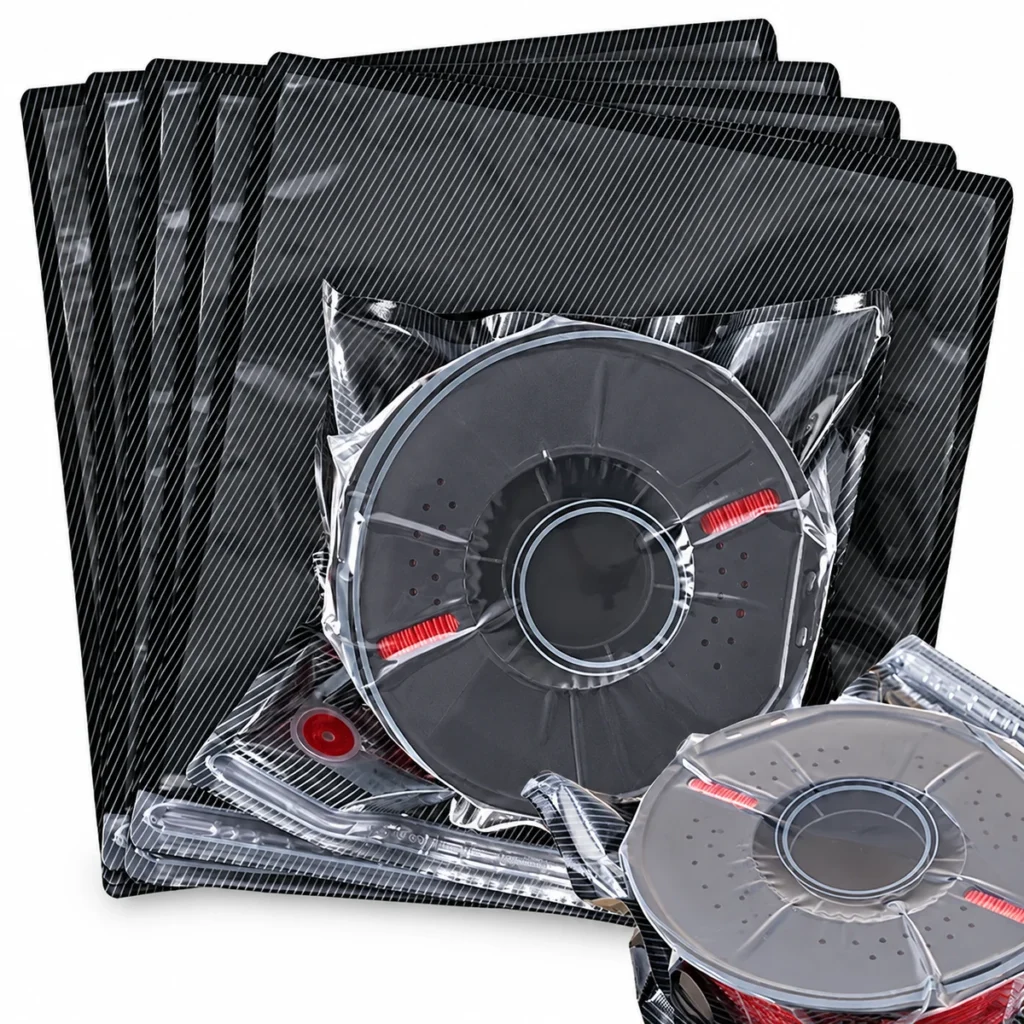
A filament vacuum storage bag kit should be specified as a complete working system, not as a bag plus a random list of accessories. At minimum, the buyer needs to define the bags, evacuation method, desiccant policy, closure components, user instructions, identification method, and external packaging. Every component must fit the same spool, valve, sales channel, and customer workflow.
The exact contents do not need to be identical across all kits. A refill pack may contain bags only. A starter set may add a compatible manual pump, while a higher-convenience retail set may use a compatible USB electric pump. The important step is to write down what is included, what is optional, and what still requires approval before a quotation is compared.
Start with the Bag Specification
The bag determines whether the rest of the kit can work. Confirm its outside dimensions, production tolerance, material structure, thickness measurement basis, closure, valve, and usable space around the spool. Nominal filament weight is not enough because spool diameter and width vary among brands.
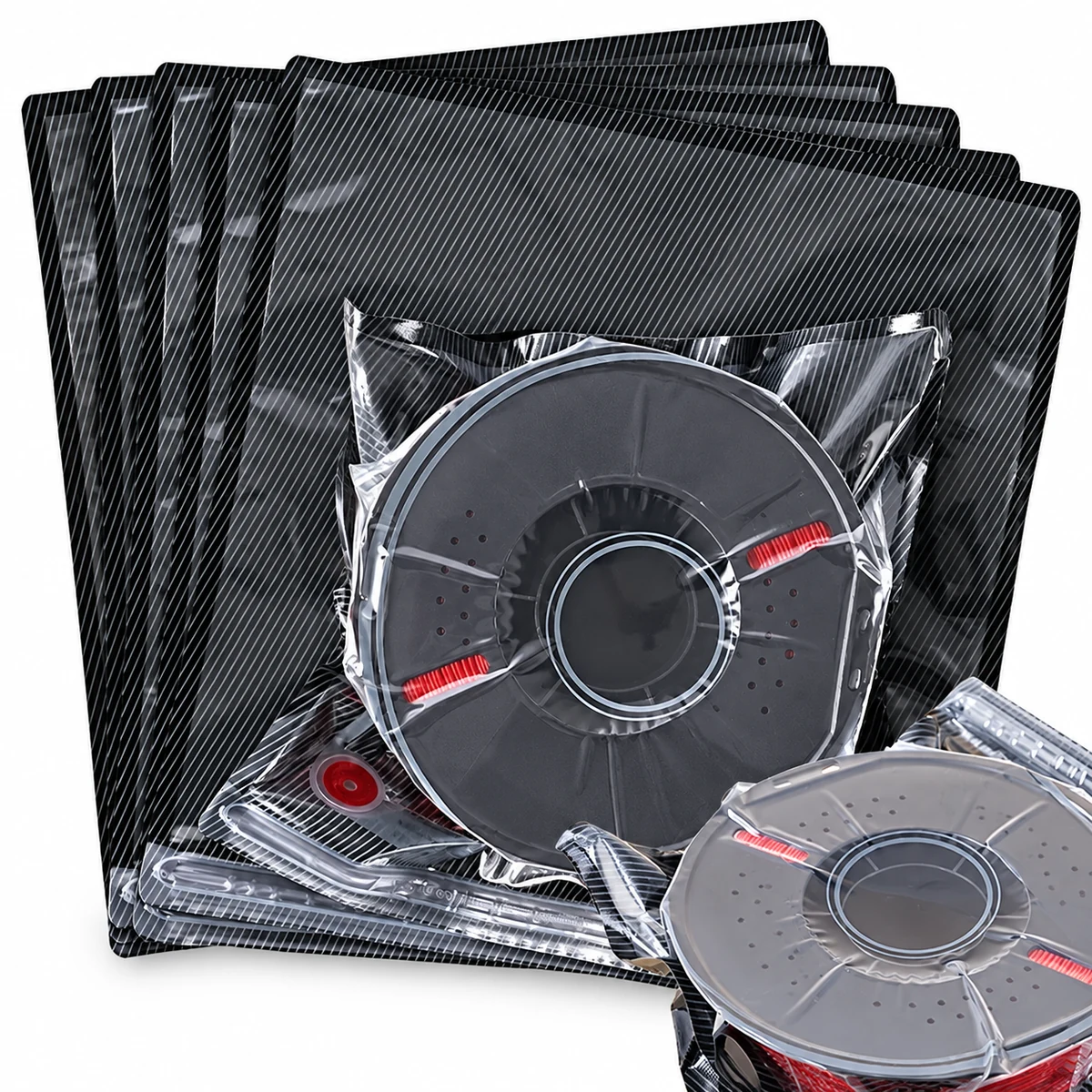
ClearNest Pack’s published 3D printer filament vacuum storage bag is 34 × 32 cm with a ±1 cm tolerance. It uses PA+PE film, a double-track zipper, and an integrated air valve. The published 0.19 mm thickness is the total for both sides combined, not a per-side measurement. This configuration must still be sample-checked against the intended spools; it is not described as fitting every 1 kg reel.
Choose the Evacuation Method
A bags-only pack is appropriate when customers already have a compatible pump. A manual pump avoids electrical requirements and is easy to include in a starter set. A USB electric pump can reduce effort for customers handling several bags, but its model, power input, connector, instructions, quantity per sales unit, and valve fit must be confirmed.
Do not assume that every pump fits every integrated valve. Approve the bag, valve, and exact pump together, then retain a reference sample. Pump speed is not a substitute for a clean zipper or sound valve bond, and the kit instructions should discourage excessive evacuation that stretches film sharply across spool edges.
Desiccant Is a Storage Aid, Not a Dryer
A dry desiccant sachet can help manage residual humidity inside a sealed bag. It cannot remove all moisture already absorbed by wet filament, repair a puncture, or compensate for an incomplete zipper. Prusa’s official filament-drying guidance distinguishes drying from prevention and recommends closed storage with desiccant; it also lists vacuum bags as a storage option. Its drybox documentation likewise states that already-moist filament must be dried first. Bambu Lab documentation also treats active drying and sealed storage as separate functions.
For a commercial kit, specify sachet type, quantity, unit packaging, indicator requirements if any, and user guidance. Keep granules and damaged sachets away from the zipper and valve. ClearNest Pack’s product information mentions one sachet per bag for a specified kit configuration, but accessory counts for a new order must be confirmed rather than assumed.
Useful manufacturer references include the official Prusa filament drying guide and Bambu Lab AMS HT documentation.
Closure Components and User Instructions
If the bag design uses a slider, define whether one is supplied per bag, per pack, or separately. The instruction sheet should show how to align and close both zipper tracks, position the pump squarely on the valve, stop at a practical vacuum level, and inspect the package after sealing. It should also state that the red valve membrane must not be removed where that instruction applies to the approved product.
Most importantly, the instructions must separate filament drying from sealed storage. A customer should understand that wet filament may need treatment according to the filament manufacturer’s guidance before it enters the bag. The existing filament vacuum-sealing guide provides a practical sequence that can inform kit instructions without promising a fixed storage duration.
Identification, Labels, and External Packaging
Reusable storage works better when users can identify the material, color, brand, spool reference, and packing date. This can be handled through a writable area, separate label, or instruction card. Avoid placing a hard label edge where it could stress the film.
Bag-body customization and external packaging are separate scopes. Printing or changing the bag dimensions, film, zipper, or valve changes the product itself. Barcodes, retail poly bags, boxes, inserts, master cartons, and shipping marks belong to the packaging program. They may have different artwork, sampling, MOQ, and timing requirements. The vacuum bag packaging guide explains these distinctions in more detail.
A Component Matrix for Quotations
| Component | What the buyer should specify | Approval check |
|---|---|---|
| Vacuum bags | Quantity, size, tolerance, PA+PE construction, total thickness basis, zipper, valve | Fit actual target spools and inspect seals |
| Pump | None, manual, or USB electric; model and quantity per kit | Test the exact pump with production valves |
| Desiccant | Type, sachet count, packing, and instructions | Confirm condition and placement |
| Slider | Included quantity and replacement policy | Check operation across both zipper tracks |
| Instructions | Language, drying/storage distinction, sealing steps, warnings | Approve final text and illustrations |
| Identification | Writable area, labels, or cards | Check adhesion, placement, and readability |
| Retail packaging | Pack count, barcode, bag or box, artwork, inserts | Approve packed sample and carton plan |
Use the matrix to normalize supplier quotations. A low unit price is not comparable if one proposal excludes pumps, desiccant, assembly, printed instructions, retail packaging, or inspection work included in another.
Sample Approval Should Cover the Complete Kit
A bag sample alone cannot approve a retail kit. Test the largest and smallest target spools, the exact pump, desiccant placement, zipper operation, valve seating, labels, instructions, and the packed retail unit. Check that components cannot damage each other during handling and that the customer can understand the sequence without unsupported performance claims.
For bag sizing, use the filament vacuum bag size guide. For a broader sourcing review covering MOQ, packaging, quality control, and quotation comparison, see the wholesale filament vacuum bag guide.
Commercial Boundaries to Confirm
The current product page states a standard non-custom bags-only MOQ of 1,000 individual bags. Custom logo printing MOQ is 30,000 pcs. These quantities do not automatically apply to manual-pump kits, USB electric-pump kits, custom dimensions, or private-label outer packaging. Component availability, electrical details, assembly, packaging, samples, MOQ, and production timing need written confirmation for the actual configuration.
Likewise, no fixed vacuum-retention period or moisture-protection lifetime should appear on a kit without a relevant test method and evidence for that exact construction and use condition. The article on how vacuum bags protect dry filament explains the limits customers should understand.
Questions Buyers Commonly Ask
Does every kit need a pump?
No. Bags-only refill packs can serve customers who already own a compatible pump. Starter or retail kits may include a manual or USB electric pump after compatibility is approved.
Should every bag include desiccant?
Desiccant is useful in many storage programs, but its type and count should be specified for the project. It does not replace proper drying or a reliable seal.
Is a 34 × 32 cm bag suitable for every filament spool?
No. Spool dimensions vary. Buyers should measure actual reels and approve usable zipper and valve clearance through samples.
Is custom retail packaging included with a custom bag?
Not automatically. Bag construction and external retail packaging are separate scopes with their own artwork, approvals, quantities, and commercial terms.
A useful kit specification identifies every component, its quantity, its compatibility check, and its approval owner. Buyers can request a filament storage kit quotation with spool dimensions, bag quantity, pump preference, desiccant requirements, instructions, and external packaging scope.