
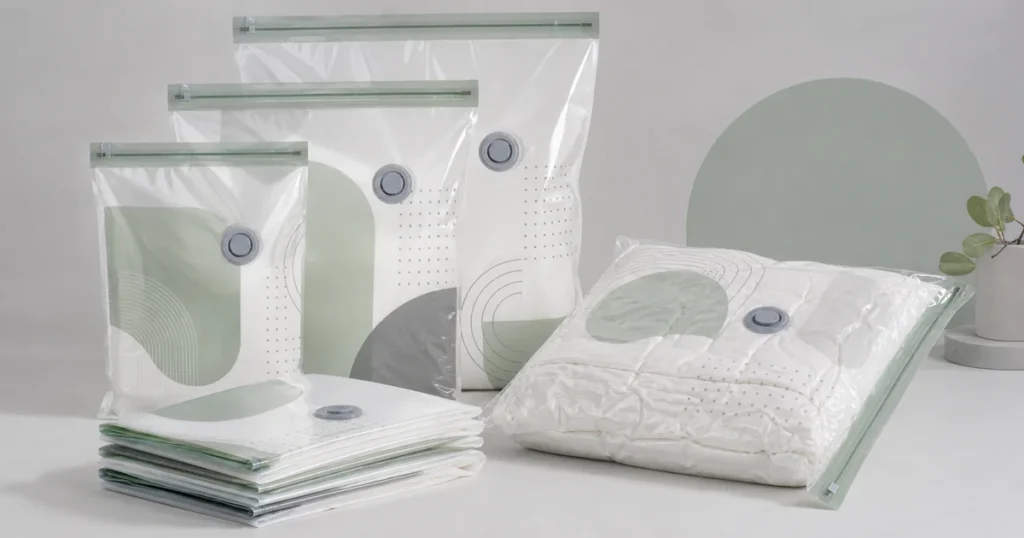
Custom printed vacuum storage bags require buyers to coordinate the bag specification and the print specification as one project. Before requesting a quotation, define the bag sizes, film structure, closure, valve, artwork, colors, print area, retail packaging, and approval process. For importers, wholesalers, and private-label brands, a clear brief is the most practical way to compare proposals and reduce avoidable revisions.
Quick Answer
Custom printed vacuum storage bags should be sourced as a coordinated product and artwork program. Buyers need to define film, dimensions, zipper, valve, print method, colors, coverage, safe areas, packaging, and approval references. The printed sample should be evaluated on the finished bag because transparency, folds, components, and contents can affect appearance.
Printing should not be approved separately from the finished bag. The selected film, surface, converting process, zipper, valve position, folds, and packaging can all affect how artwork appears. Buyers can review the available Custom Printed Vacuum Storage Bags while preparing a brief, but every custom program still needs its own confirmed construction and artwork references.
Start with the Product and Market Requirements
Begin by defining what the bag will store, how it will be evacuated, where it will be sold, and how customers will receive instructions. Clothing, bedding, and travel formats can require different dimensions, closures, valves, and pack arrangements. The artwork must fit the actual product rather than a generic template.
Record the target bag dimensions and clarify whether they describe the external size, usable space, or another agreed basis. Identify the zipper, valve, seal areas, and intended folds. A dimensioned drawing helps the buyer and manufacturing partner understand where graphics can be placed without covering functional components or entering areas that may distort.
Define the Sales Channel
Printed vacuum bags wholesale programs may serve retail stores, distributors, marketplaces, or direct-to-consumer private-label operations. Each channel can have different packaging, barcode, language, image, and instruction requirements. Document these needs before artwork begins so the same information appears consistently on the bag, insert, retail pack, and online listing.
Choose a Suitable Film and Bag Construction
Artwork quality depends partly on the print surface, but print appearance should not replace functional evaluation. Buyers should confirm the proposed film structure, nominal thickness basis, transparency or opacity, surface characteristics, zipper, valve, and perimeter seals. The complete bag must remain suitable for the intended use after printing and converting.
PA and PE may be used in multilayer vacuum storage bag constructions, with each material contributing different general characteristics. However, a material label alone does not establish printing suitability or finished performance. The PA PE vacuum storage bag material guide explains why buyers should compare documented structures and traceable finished samples instead of relying only on material names.
Ask whether the proposed printing process or surface preparation changes any aspect of the approved film. If transparent windows are required, define their location and purpose. If an opaque or colored area is proposed, review how it looks over both an empty bag and the intended contents.
Compare Vacuum Bag Printing Methods
Vacuum bag printing methods should be discussed with the supplier according to artwork complexity, colors, coverage, film, order configuration, and expected appearance. Process names can be used differently, so request a written proposal and representative samples. Do not assume that one method is universally best.
| Printing consideration | Buyer questions | Approval evidence |
|---|---|---|
| Process | Which method is proposed for this film, artwork, and order? | Written quotation and representative samples |
| Color | How will colors be referenced, matched, and approved? | Agreed color reference or approved printed sample |
| Coverage | What print area, transparent window, and unprinted margins are practical? | Dimensioned artwork and bag drawing |
| Registration | What alignment expectations apply between colors and bag components? | Approved sample and inspection criteria |
| Surface appearance | How should gloss, density, and visual consistency be assessed? | Signed visual reference under agreed viewing conditions |
| Change control | How are revised files identified before production? | Final filename, revision number, and written approval |
Printed Film Versus Labels or Inserts
Direct printing is not the only way to carry branding and instructions. Depending on the project, labels, inserts, retail cartons, or other packaging elements may carry some information. Buyers should decide which content must remain on the bag throughout use and which content belongs in the retail presentation.
A mixed approach can sometimes simplify artwork management across sizes or markets, but it also adds components that require their own approval and packing controls. Compare the complete landed program rather than evaluating the bag print in isolation.
Prepare Production-Ready Artwork
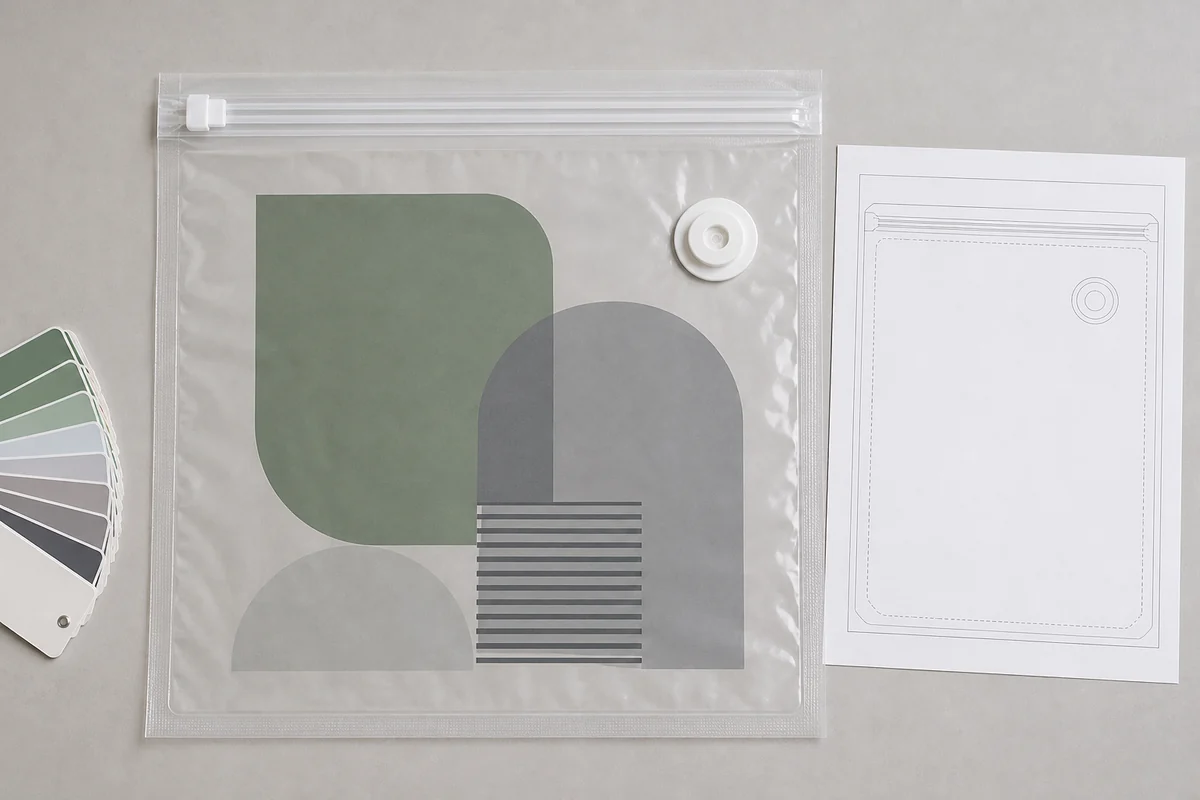
Provide artwork in the file format requested by the manufacturing partner and keep editable source files under revision control. Include the correct bag outline, print boundaries, component positions, color references, language versions, barcode placement, and any required instructions. Fonts and linked graphics should be handled according to the supplier’s artwork requirements.
Use a clear naming convention so buyers, designers, and suppliers can identify the latest approved version. Avoid filenames such as “final-new” that become ambiguous after another revision. A practical record includes the product code, size, market or language, revision, and approval date.
Plan Artwork Around Functional Areas
Keep critical text and small graphics away from zipper tracks, perimeter seals, valve openings, folds, and strongly curved areas. The artwork drawing should identify a safe print area for the approved construction. Test legibility on a finished, folded, and filled sample rather than reviewing only a flat screen proof.
For custom logo vacuum storage bags, confirm the logo version, proportions, color reference, and minimum acceptable appearance. Do not let software previews substitute for a physical approval when film transparency, surface texture, or underlying contents may change the visual result.
Use a Controlled Sample Approval Process
Sampling should answer specific questions. A structural sample can confirm size, closure, valve, and handling before final print preparation. A printed sample or another agreed print reference can then address artwork, placement, color, and surface appearance. The appropriate sequence depends on the project and should be confirmed before costs and timing are assumed.
- Approve the product brief: size, film, zipper, valve, seals, printing, and packaging.
- Approve the drawing: dimensions, component positions, print boundaries, and folds.
- Approve the artwork: revision, colors, language, barcode, instructions, and legal copy supplied by the buyer.
- Review a traceable sample: record which specification, artwork file, and process it represents.
- Document comments: identify each requested change and confirm the revised reference.
- Freeze the approval set: retain the signed specification, drawing, artwork, and sample reference for production and inspection.
Digital proofs can be useful for checking content and placement, but they may not reproduce film transparency, ink appearance, or finished-bag distortion. Buyers should understand what each proof can confirm and what remains subject to physical sample approval.
MOQ, Pricing, and Lead-Time Questions
MOQ for custom printed vacuum storage bags is project-specific. It may be influenced by film preparation, printing setup, colors, bag sizes, valve choices, packaging components, and how variants are combined. ClearNest Pack does not present an unconfirmed universal MOQ; buyers should request terms for the actual assortment.
Ask suppliers to separate setup-related costs, sample costs if applicable, unit pricing, packaging assumptions, and the effect of multiple artwork versions. Confirm whether the quotation is based on one size and design or a mixed program. Lead time should be confirmed after specifications, artwork, components, packaging, and approval steps are understood.
Coordinate Retail Packaging and Instructions
Private label vacuum bags may be folded into printed boxes, bags, sleeves, or other agreed retail formats. Packaging should protect printed surfaces, valves, and closures without creating unnecessary stress. Confirm folding direction, pack count, inserts, sliders or pumps, barcode location, labels, and master-carton organization.
Instructions should match the approved valve and closure. Use clear steps for filling, closing, evacuating, securing the valve, and storing the bag. Avoid broad compatibility or performance promises unless they have been substantiated for the intended product and market.
Quality Control for Custom Printing
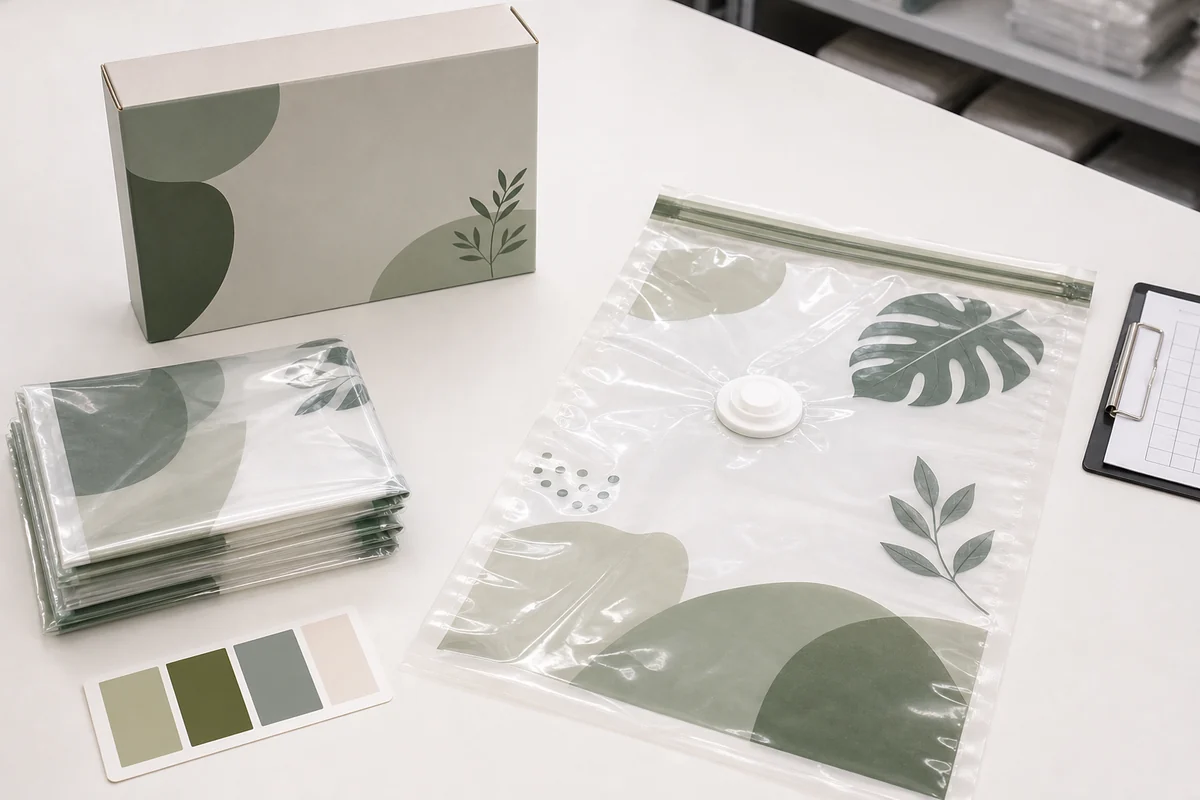
Quality inspection should connect the purchase order with the approved specification, artwork, drawing, samples, and packaging reference. Inspectors need the correct revision and objective criteria. Vague instructions such as “printing must be perfect” do not help buyers and suppliers make consistent decisions.
| Inspection area | What to check | Reference |
|---|---|---|
| Artwork version | Correct design, language, barcode, and revision | Approved artwork file |
| Placement | Orientation, print boundaries, valve clearance, and fold relationship | Dimensioned drawing |
| Color and appearance | Comparison under agreed viewing conditions | Approved color or printed sample |
| Registration | Alignment between colors and important graphics | Buyer-defined criteria |
| Workmanship | Unwanted marks, missing print, contamination, or visible transfer | Defect definitions and limit samples |
| Finished function | Zipper, valve, seals, and bag operation remain acceptable | Approved functional procedure |
| Packaging | Correct fold, components, labels, pack count, and carton arrangement | Approved packaging reference |
B2B Sourcing Checklist
- Define the end use, target market, sales channel, sizes, contents, and evacuation method.
- Confirm film structure, nominal thickness basis, transparency, zipper, valve, and seals.
- Request the proposed printing process, color-control method, print area, and sample route.
- Prepare dimensioned, revision-controlled artwork with safe areas around functional components.
- Approve traceable structural, print, and packaging references as appropriate.
- Confirm project-specific MOQ, pricing basis, artwork variants, packaging, and lead time.
- Create inspection criteria for artwork, placement, color, workmanship, bag function, and packing.
- Require written review before any material, component, artwork, or packaging change.
Frequently Asked Questions
What information is needed to quote custom printed vacuum storage bags?
Provide intended use, bag sizes, film and thickness requirements if confirmed, zipper and valve preferences, quantities by variant, artwork colors and coverage, packaging, target market, and requested sample or inspection steps. Mark uncertain items for supplier discussion.
Can a custom logo be printed on transparent vacuum bags?
Custom printing may be available on suitable constructions. The buyer should confirm the proposed film, process, print area, surface preparation, color reference, and approval method with the manufacturing partner before making commitments.
How should buyers approve printed colors?
Agree on a practical color reference and viewing method, then document the approved sample or reference. Screen colors alone may not represent printing on transparent or flexible film accurately.
Why can MOQ change between printed projects?
MOQ may depend on printing setup, film, colors, sizes, components, packaging, and the number of artwork variants. Request a written commercial proposal for the actual configuration instead of applying a figure from another product.
What should be checked before production begins?
Confirm that the purchase specification, drawing, artwork revision, samples, packaging reference, quotation, and inspection checklist describe the same product. Resolve any open items in writing before approval.
Build a Clear Private-Label Brief
ClearNest Pack supports importers, wholesalers, distributors, private-label brands, and online retailers with vacuum storage bag sourcing, customization, and export coordination through appropriate production teams.
Looking for custom vacuum storage bags for your market? Contact ClearNest Pack to discuss sizes, materials, printing, packaging and order requirements.