
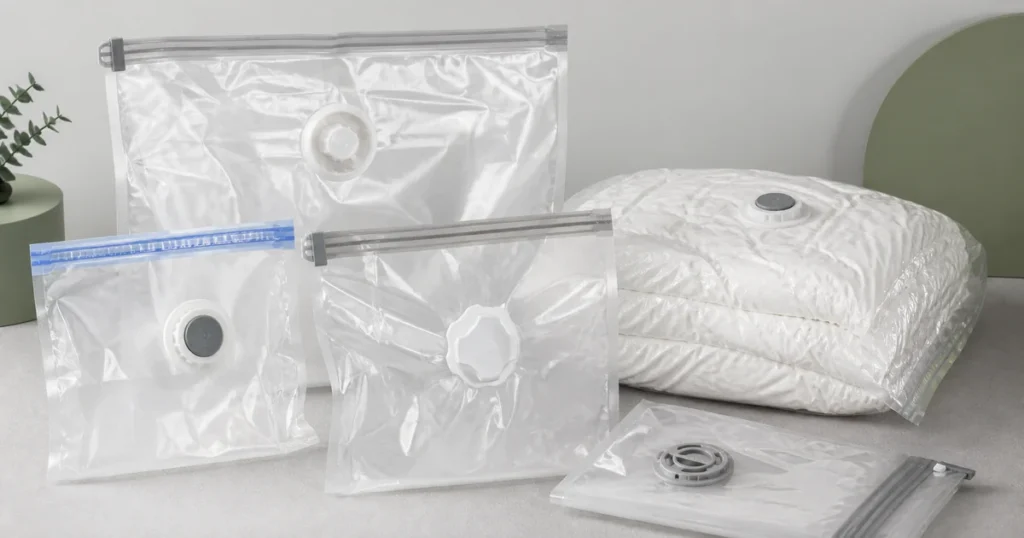
Vacuum bag valve types should be selected according to the intended evacuation method, bag construction, target market, and quality requirements—not appearance alone. For importers, wholesalers, distributors, and private-label brands, the best valve is one that works consistently with the approved bag, closure, pump or household equipment, instructions, and packaging system. Buyers should compare complete samples and document the valve assembly before confirming an order.
Quick Answer
The appropriate vacuum bag valve depends on the intended pump or household equipment, bag construction, target market, and operating instructions. Buyers should compare the complete valve assembly—not just its name—and verify cap design, internal one-way component, film attachment, nozzle compatibility, packaging clearance, and finished-bag performance using traceable samples.
This guide explains the practical differences buyers may encounter, the questions to include in a quotation request, and how to evaluate valve compatibility without relying on unsupported performance claims. Buyers can also review the Transparent Vacuum Storage Bags to see where valve, size, film, closure, printing, and packaging decisions fit into a custom program.
Why the Valve Type Matters in B2B Sourcing
A vacuum storage bag depends on several connected elements: film, perimeter seals, zipper closure, valve body, internal valve component, cap, and user operation. The valve provides the evacuation path, but it must also help limit air return after the pump or nozzle is removed. A suitable component can still perform poorly if it is assembled incorrectly, paired with an unsuitable opening, or used with unclear instructions.
For B2B programs, valve selection affects more than the bag itself. It can influence compatibility claims, instruction artwork, pack contents, customer support questions, replacement-component planning, and inspection criteria. A buyer should therefore treat the vacuum storage bag valve as a specified component rather than a generic accessory.
Common Vacuum Bag Valve Types
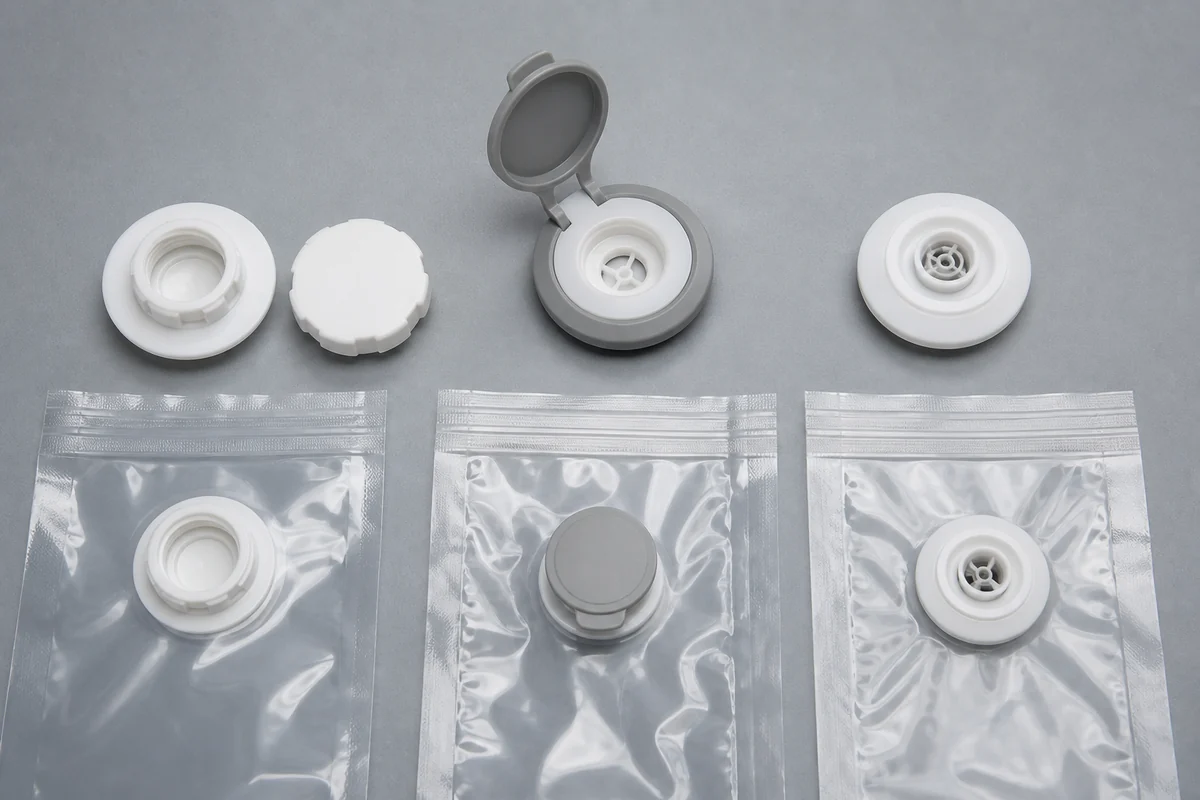
Suppliers may describe valves by operating method, cap design, internal mechanism, pump interface, or proprietary component reference. Terminology is not always consistent across manufacturers. Instead of relying only on a name, request photographs, drawings, component samples, and a description of the intended evacuation method.
| Valve approach | Typical buyer consideration | Points to verify |
|---|---|---|
| Screw-cap valve | A removable or hinged cap covers the evacuation opening | Cap fit, attachment, opening direction, internal component, and loss prevention |
| Flip-cap valve | The cap remains connected and opens for evacuation | Hinge durability, closure feel, molding consistency, and packaging clearance |
| Low-profile valve | A flatter assembly may support compact folding or presentation | Nozzle access, airflow path, component height, and folded-pack pressure |
| Pump-specific interface | The opening is designed around an agreed manual or electric pump | Exact pump reference, fit, operating steps, and pack inclusion |
| Household-vacuum interface | The opening is intended for an agreed range of vacuum-cleaner nozzles | Target-market equipment, nozzle contact, instructions, and claim limitations |
These categories can overlap. A screw-cap design may also be low profile, and a household-vacuum interface may use different internal one-way structures. Buyers should compare the physical component and approved operating process rather than assume that identical marketing terms indicate identical construction.
One-Way Vacuum Valve Mechanisms
A one-way vacuum valve is intended to allow air to leave while helping resist reverse flow. The internal mechanism may use a flexible element, plug, membrane, or another supplier-specific construction. The finished result depends on component dimensions, material behavior, assembly, cleanliness, and the surface around the valve.
Do not specify an internal mechanism solely because it appears more complex. Ask the manufacturing partner to identify the proposed assembly, provide representative samples, and explain the operating steps. Any performance requirement should be agreed with a defined method and observation period rather than described with vague terms such as “airtight forever.”
Cap Design and Retention
The cap can protect the opening and provide an additional closure step, but buyers should understand whether it is essential to the functional seal or primarily protective. Check whether the cap is attached, how it is opened, and whether it may loosen during distribution or use. If it is removable, the packaging and instructions may need to reduce the risk of loss.
Match the Valve to the Evacuation Method
Vacuum bag valve compatibility should be confirmed for the equipment customers are expected to use. A statement such as “works with vacuums” is too broad unless the relevant equipment range and operating method have been evaluated. Nozzle shapes, contact surfaces, airflow, and user technique can vary.
For Travel Compression Bags sold with a manual pump, approve the pump and valve together. Confirm how the pump connects, how many components are included, and how they will be arranged in the retail pack. For products intended for household equipment, make the instructions neutral and accurate unless compatibility with specific equipment has been verified. The broader storage compression bags guide explains how valve-based and manual formats differ.
Online retailers and distributors should also consider after-sale clarity. Product listings, printed instructions, and customer-service scripts should describe the same operating sequence. If the valve requires the cap to be tightened after evacuation, that step must be visible. If the nozzle should not press against an internal part, the illustration should make that clear.
Valve Integration with Film and Bag Structure
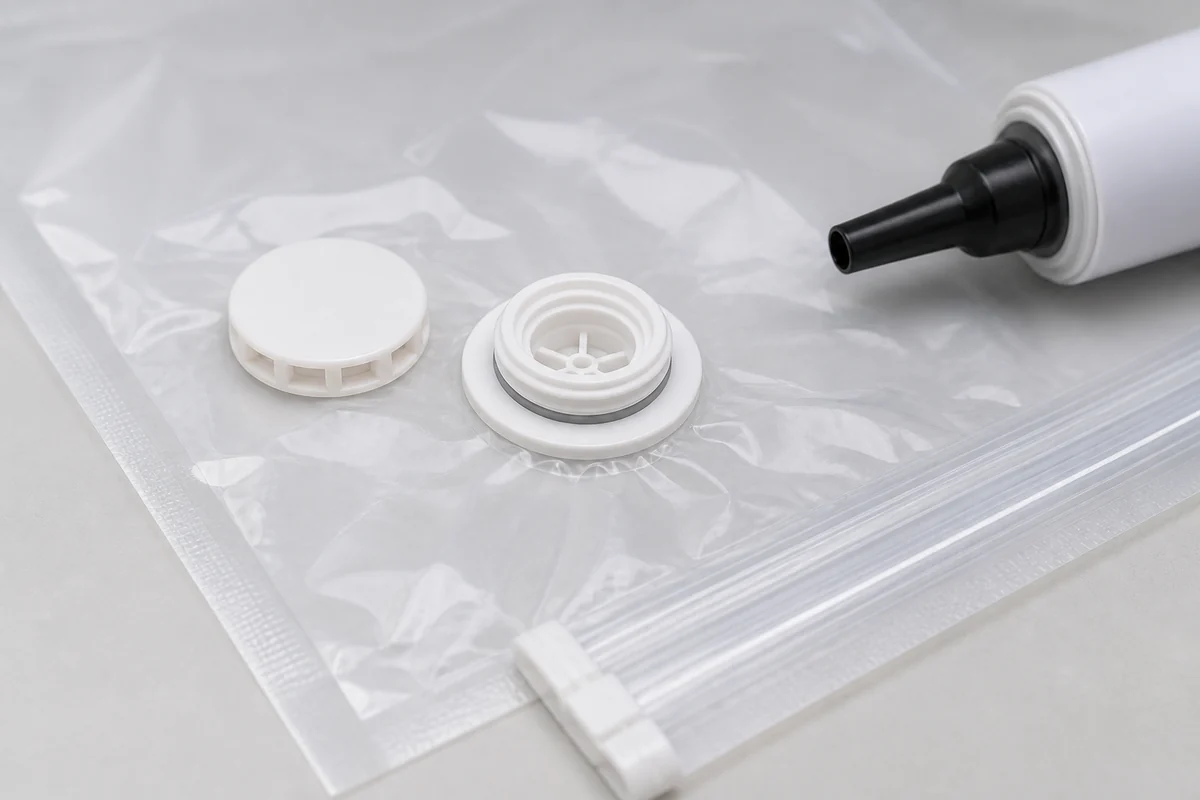
The valve does not operate independently of the film. Its attachment area must be suitable for the proposed film structure, hole geometry, valve parts, and converting process. Buyers should inspect the area around the valve for distortion, incomplete attachment, contamination, or stress that could contribute to vacuum storage bag leakage.
Bag dimensions and fill conditions also matter. A valve placed too close to a fold, zipper, perimeter seal, or bulky contents may be difficult to access. Artwork should not obscure operating features or interfere with visual inspection. For printed OEM vacuum storage bags, approve the component position on a dimensioned drawing before approving final artwork.
Film thickness is only one part of this system. The existing vacuum storage bag thickness guide explains why nominal film measurements should be reviewed together with seals, valves, closure design, and workmanship.
Closure, Seal, and Valve Troubleshooting
When a sample loses compression, the valve is one possible cause, but it should not be blamed automatically. Air may enter through an incompletely closed zipper, a perimeter-seal issue, film damage, debris, a misassembled valve, or incorrect operation. A structured investigation avoids unnecessary component changes.
- Confirm the operating sequence: close the zipper completely, evacuate according to the approved instructions, and secure the valve or cap as specified.
- Inspect the closure: check zipper alignment, end areas, and any supplied slider without forcing the closure.
- Inspect the valve area: look for visible distortion, loose parts, contamination, or damage around the attachment.
- Inspect the remaining bag: check folds, corners, perimeter seals, and surfaces for handling damage.
- Record the conditions: identify the sample, contents, equipment, operator steps, and observed location of the problem.
If a concern repeats, compare affected and unaffected samples from the same traceable lot under the same buyer-approved procedure. Share photographs and observations with the manufacturing partner. This produces more useful corrective information than a general complaint that the valve “does not work.”
Customization, MOQ, and Packaging Questions
Valve color, cap style, pump inclusion, printing, bag size, and retail packaging may be customizable, but availability should be confirmed for each program. A custom color may depend on component sourcing and color approval. A new component combination may require additional sampling. Buyers should keep unconfirmed options out of final sales materials.
MOQ is project-specific. Valve sourcing, bag sizes, film preparation, printing setup, pumps, instructions, and packaging can all influence the commercial proposal. Instead of assuming a fixed minimum, provide the expected assortment and ask which choices affect the quoted MOQ. Lead time should likewise be confirmed after the construction, artwork, packaging, and approval steps are defined.
Packaging should protect the valve from unnecessary pressure during folding, packing, transit, and storage. A well-made vacuum storage bag can still reach the customer in poor condition if the pack format places repeated stress on the valve or closure. Review folding orientation, insert placement, pack dimensions, and master-carton arrangement using production-representative samples.
Quality Inspection for Vacuum Bag Valves
A useful inspection plan links the purchase specification, approved sample, component reference, and operating method. Inspectors should know which valve is approved and how to distinguish it from alternatives. Visual inspection alone may not reveal assembly or compatibility issues, so include agreed functional checks using the specified equipment and representative contents.
| Inspection item | Buyer check | Reference |
|---|---|---|
| Valve identity | Correct design, color, cap, and internal parts | Approved sample and component image |
| Position | Location and orientation match the approved drawing | Dimensioned specification |
| Assembly | Parts are complete, seated consistently, and visibly clean | Workmanship criteria |
| Operation | Valve opens, connects, evacuates, and closes as agreed | Approved instructions and equipment |
| Finished bag | Valve, zipper, seals, film, and contents work as a system | Buyer-defined functional procedure |
| Packaging | Folding and pack components do not create avoidable pressure | Approved packaging sample |
B2B Valve Selection Checklist
- Define the bag use, contents, sizes, target market, and expected evacuation equipment.
- Request the exact valve reference, photographs, component description, and proposed position.
- Confirm cap style, retention method, internal mechanism, and operating steps.
- Approve the valve together with the film, zipper, perimeter seals, and finished bag.
- Test representative samples with the intended pump or equipment and realistic contents.
- Align product listings, artwork, instructions, and customer-support language.
- Confirm customization, pump inclusion, packaging, MOQ, and lead time for the actual configuration.
- Create inspection criteria that identify both the component and the agreed functional procedure.
Frequently Asked Questions
Which vacuum bag valve type is best?
There is no universal best valve. The appropriate choice depends on the intended equipment, bag design, contents, market, operating instructions, packaging, and buyer-defined quality requirements. Compare complete, traceable samples under the same procedure.
Are all vacuum storage bag valves compatible with household vacuums?
No broad compatibility should be assumed. Household nozzle designs and operating conditions vary. Buyers should define the target use, evaluate representative equipment where practical, and word compatibility claims carefully.
Can the valve color or design be customized?
Customization may be available through appropriate production teams, but component options, color matching, sampling, MOQ, and timing must be confirmed for the project. Do not promise a custom option before written confirmation.
How can buyers determine whether leakage comes from the valve?
Check the operating process, zipper, perimeter seals, film surface, folds, and valve assembly under controlled conditions. Document where and when the issue appears. This helps separate valve concerns from closure, film, packing, or handling issues.
Should a valve test be included in pre-shipment inspection?
Include an agreed functional check when valve operation is important to the purchase specification. Define the equipment, contents, steps, sample selection, observation method, and acceptance criteria before inspection.
Prepare a Complete Valve Specification
ClearNest Pack supports B2B buyers with vacuum storage bag sourcing, customization, and export coordination through appropriate production teams. A clear specification helps buyers compare valve options together with materials, sizes, closures, printing, and packaging.
Looking for custom vacuum storage bags for your market? Contact ClearNest Pack to discuss sizes, materials, printing, packaging and order requirements.