
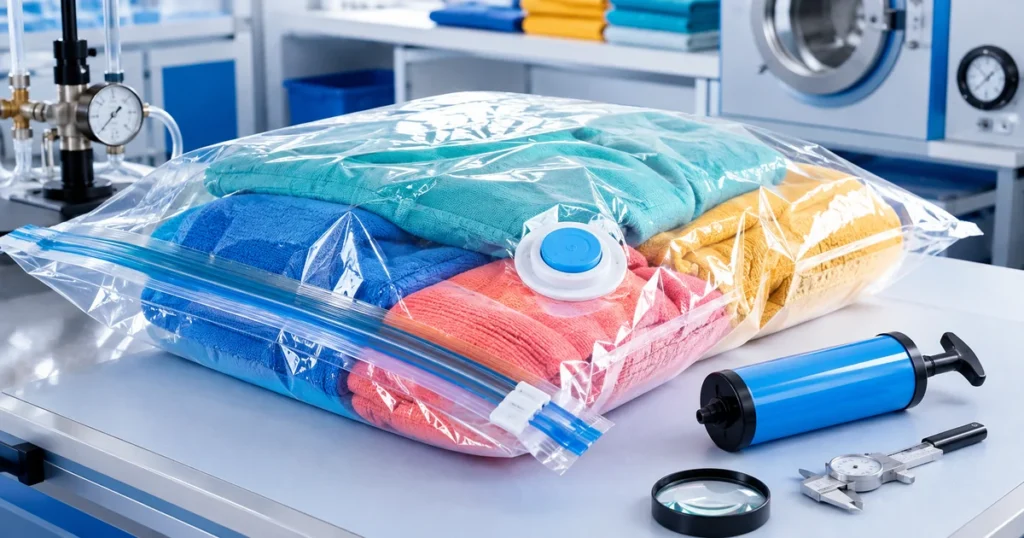
For importers, wholesalers, distributors, retailers, and private-label brands, a vacuum storage bag is only useful if the complete bag system can maintain the intended compressed condition during normal use.
Film thickness is important, but air leakage does not come from film alone. The zipper, valve, perimeter seals, component assembly, handling, and even the way the bag is closed can all affect performance.
For this reason, vacuum storage bag quality control should evaluate the finished bag as a complete system rather than checking only one material specification.
This guide explains how B2B buyers can approach vacuum storage bag leak testing, what areas should be inspected, and what should be agreed with a supplier before bulk production or shipment.
Buyers developing a new product can also review our Custom Vacuum Storage Bags options when defining size, construction, printing, and packaging requirements.
Quick Answer
A vacuum storage bag leak test is used to identify whether unwanted air enters a closed and evacuated bag through the zipper, valve, perimeter seals, film, or other assembled areas.
There is no single testing time or pass/fail condition that is suitable for every product.
For B2B orders, the test method should be defined according to the agreed product specification, intended contents, bag size, and inspection requirements.
A practical quality-control plan may include:
- Visual inspection
- Zipper closure inspection
- Valve inspection
- Perimeter seal inspection
- Vacuum evacuation
- Air-retention observation
- Comparison with an approved sample
- Batch sampling according to the agreed inspection plan
The purpose is not simply to say that a bag has been “tested.” The buyer and supplier should agree how it is tested and what constitutes an acceptable result.
Why Vacuum Storage Bags Can Lose Vacuum
When buyers experience a bag gradually expanding after compression, it is easy to assume that the film itself is defective.
In practice, several parts of the finished bag should be investigated.
1. Zipper Closure
The zipper is one of the most important sealing areas.
If the closure is not completely engaged, even a small unclosed section can allow air to enter the bag.
During inspection, check:
- Zipper alignment
- Closure along the entire width
- Slider operation, where applicable
- Wrinkles or folded film around the zipper
- Contamination inside the closure
A bag should therefore be tested using the same closing method that the end customer is expected to follow.
For more detail on another critical component, buyers can review our Vacuum Bag Valve Types guide.
2. Vacuum Valve and Valve Assembly
The valve controls air evacuation and then becomes part of the airtight system after compression.
A valve-related problem may result from the component itself, assembly, fit, cap position, or compatibility with the selected evacuation method.
Inspection should confirm:
- Correct valve type
- Correct installation position
- Proper assembly
- Secure cap or closure
- No obvious damage
- Compatibility with the intended pump or vacuum method
The valve should not be evaluated independently from the finished bag. Valve position, bag construction, and user operation all affect the complete system.
3. Perimeter Heat Seals
Vacuum storage bags usually contain several sealed edges created during converting.
These seals need to withstand the stresses created when the bag is filled, evacuated, folded, packed, and handled.
Inspectors should look for:
- Incomplete sealing
- Irregular seal appearance
- Wrinkling inside the seal area
- Contamination
- Localized weak areas
- Damage caused during converting or packing
A visual inspection cannot prove long-term performance by itself, but it can identify obvious workmanship problems before functional testing begins.
4. Film Damage and Punctures
A vacuum storage bag may also lose air because of very small holes or physical damage.
Possible causes include:
- Sharp objects inside the bag
- Rough handling
- Damage during folding
- Contact with carton staples or sharp packaging edges
- Excessive stress around corners
- Damage during production or transport
This is why testing should use representative contents and realistic handling conditions where possible.
Material specification still matters, but material alone does not determine whether the finished product will remain airtight.
Buyers who want more information about film construction can read our PA+PE Vacuum Storage Bags material guide.
A Practical Vacuum Storage Bag Leak Test Process
A factory or third-party inspector may use different procedures depending on the project, but a basic functional evaluation can follow a structured sequence.
Step 1: Select Representative Samples
Samples should represent the production batch rather than being selected only from especially good-looking products.
For multi-size orders, testing should consider the different sizes included in the purchase order.
Large vacuum storage bags can experience different stresses from smaller bags, so testing only one SKU may not represent an entire assortment.
The number of samples and acceptance rules should be agreed between buyer and supplier.
Step 2: Inspect the Bag Before Filling
Before using the bag, check:
- Film appearance
- Dimensions
- Zipper condition
- Valve condition
- Perimeter seals
- Visible contamination
- Printing, if applicable
Record any obvious defect before beginning the functional test.
This makes it easier to distinguish a pre-existing workmanship problem from damage caused during testing.
Step 3: Add Representative Contents
The contents used during testing should reflect the intended application.
Typical products may include:
- Clothing
- Blankets
- Bedding
- Quilts
- Comforters
- Other soft household textiles
Avoid sharp objects that are not representative of normal use.
For large-capacity bedding applications, buyers may also review our 3D Vacuum Storage Bags.
Step 4: Close the Zipper Correctly
Run the closure across the entire opening and verify that there are no visible gaps.
This step is important because an incorrectly closed zipper can produce an apparent leak even when the bag itself is properly manufactured.
For consistent B2B testing, the closing procedure should be documented so that different inspectors use the same method.
Step 5: Evacuate the Air
Remove air using the evacuation method specified for the product.
Depending on the bag configuration, this may involve:
- Vacuum cleaner
- Manual pump
- Electric pump
- Another project-approved method
Do not assume that every pump or vacuum system is compatible with every valve.
For bag-and-pump programs, see our Vacuum Storage Bags with Pump page.
Step 6: Secure the Valve
After evacuation, confirm that the valve has returned to its intended closed condition and that any cap or cover is properly secured.
The bag can then be visually inspected for immediate expansion or other abnormalities.
Step 7: Observe Air Retention
The compressed bag should be observed according to the agreed test procedure.
Rather than using an unsupported universal statement such as “Every vacuum bag must stay compressed for X days,” B2B buyers should define the actual test conditions.
These may include:
- Observation period
- Storage orientation
- Approximate fill level
- Bag size
- Type of contents
- Environmental conditions
- Acceptable dimensional change
- Pass/fail criteria
This produces a more useful quality record than simply stating that a “leak test” was performed.
Batch Testing vs Testing Every Bag
For commercial production, buyers should clearly understand the difference between 100% inspection and batch sampling.
They are not the same thing.
A supplier should not claim that every individual bag undergoes a particular functional test unless that is actually part of the production and inspection process.
A more appropriate B2B approach is often to establish a batch-level inspection and sampling plan based on the agreed requirements.
This can include checks during production as well as finished-product inspection before packing or shipment.
The inspection plan should identify:
- Which characteristics are checked
- Sampling quantity
- Inspection frequency
- Test procedure
- Acceptance criteria
- Required records
This is especially important for repeat orders because the same inspection reference can then be used to compare production batches over time.
Leak Testing Should Not Be the Only Quality Check
A bag can pass an air-retention test and still have another commercial defect.
For private-label or retail programs, inspection may also need to cover:
| Inspection Area | What Buyers Should Check |
|---|---|
| Dimensions | Correct size and agreed measuring method |
| Film | Appearance and agreed specification |
| Zipper | Alignment and closing operation |
| Valve | Correct component and assembly |
| Perimeter seals | Visible workmanship and integrity |
| Printing | Correct artwork, position, and appearance |
| Packaging | Pack count, folding, and components |
| Labels | Barcode, SKU, and required information |
| Cartons | Quantity and carton markings |
This is why the finished product should be compared against the purchase specification and approved reference sample.
For buyers sourcing complete commercial programs, our Vacuum Storage Bags Wholesale guide covers additional purchasing considerations.
What B2B Buyers Should Ask Their Supplier
How are finished bags checked for leakage or air retention?
Ask for the actual process rather than accepting a general statement such as “quality is guaranteed.”
Is testing performed per batch or on every unit?
This avoids misunderstanding about the inspection scope.
Which bag sizes are included in the inspection?
A multi-size order should not automatically be represented by one convenient size.
What sample or specification is used as the reference?
The approved sample, product specification, and inspection criteria should refer to the same product revision.
Can inspection records or photos be provided when required?
Agree this before production if documentation is important for your purchasing process.
How are defects handled if a sample fails?
The supplier should have a defined method for segregation, additional inspection, or corrective action based on the project requirements.
Quality Control for Custom and Private-Label Orders
Custom printed and private-label vacuum storage bags add more variables to the inspection process.
In addition to functional performance, buyers may need to verify:
- Logo version
- Artwork orientation
- Printing position
- Colors
- Retail packaging
- Set configuration
- Pump or accessories
- Labels
- Carton markings
The quality-control document should therefore reference the finished approved SKU, not just a generic vacuum storage bag specification.
Buyers planning a branded product range can review our Private Label Vacuum Storage Bags page.
Final Checklist
Before approving a vacuum storage bag order, confirm:
- Bag dimensions
- Material specification
- Thickness basis
- Zipper configuration
- Valve configuration
- Intended evacuation method
- Leak-test procedure
- Sampling plan
- Acceptance criteria
- Approved reference sample
- Printing requirements
- Packaging configuration
- Pre-shipment inspection requirements
A well-defined testing process helps both buyer and manufacturer evaluate the same product against the same expectations.
Conclusion
Vacuum storage bag leak testing should focus on the complete finished bag, including the film, zipper, valve, and perimeter seals.
For B2B orders, the most important step is not choosing an arbitrary test duration. It is establishing a repeatable test method, representative samples, and clearly agreed acceptance criteria.
Importers, wholesalers, distributors, and private-label brands should confirm these requirements before bulk production so that samples, production, and final inspection can all be evaluated against the same reference.
If you are developing a wholesale or private-label vacuum storage bag program, review ClearNest Pack’s vacuum storage bag manufacturing capabilities or contact us to discuss your required sizes, construction, packaging, and inspection requirements.